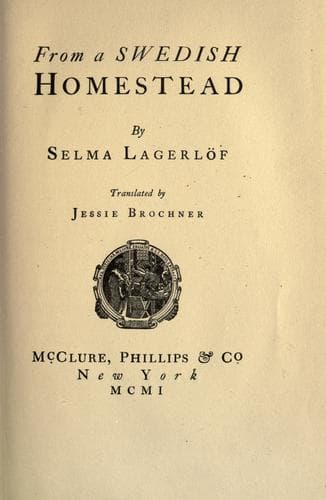
Short stories, Swedish -- Translations into English; Sweden -- Social life and customs -- Fiction
The thought of death now came quite gently to him. He thought about the
whole of the funeral and all the honour they would show his dead body.
He could see the table laid for the great funeral feast in the large
room on the first floor, the Dean and his wife in the seats of honour,
the Justice of the Peace, with the white frill spread over his narrow
chest; the Major's wife in full dress, with a low silk bodice, and her
neck covered with pearls and gold; he saw all the best rooms draped in
white--white sheets before the windows, white over the furniture;
branches of fir strewn the whole way from the entrance-hall to the
church; house-cleaning and butchering, brewing and baking for a
fortnight before the funeral; the corpse on a bier in the inmost room;
smoke from the newly-lighted fires in the rooms; the whole house crowded
with guests; singing over the body whilst the lid of the coffin was
being screwed on; silver plates on the coffin; twenty loads of wood
burned in a fortnight; the whole village busy cooking food to take to
the funeral; all the tall hats newly ironed; all the corn-brandy from
the autumn drunk up during the funeral feast; all the roads crowded with
people as at fair-time.
Again the old man started up. He had heard them sitting and talking
about him during the feast.
'But how did he manage to go and get frozen to death?' asked the Justice
of the Peace. 'What could he have been doing in the large forest?'
And the Captain would say that it was probably from Christmas ale and
corn-brandy. And that roused him again. The Ingmars had never been
drunkards. It should never be said of him that he was muddled in his
last moments. And he began again to walk and walk; but he was so tired
that he could scarcely stand on his legs. It was quite clear to him now
that he had got far into the forest, for there were no paths anywhere,
but many large rocks, of which he knew there were none lower down. His
foot caught between two stones, so that he had difficulty in getting it
out, and he stood and moaned. He was quite done for.
Suddenly he fell over a heap of fagots. He fell softly on to the snow
and branches, so he was not hurt, but he did not take the trouble to get
up again. He had no other desire in the world than to sleep. He pushed
the fagots to one side and crept under them as if they were a rug; but
when he pushed himself under the branches he felt that underneath there
was something warm and soft. This must be a bear, he thought.
He felt the animal move, and heard it sniff; but he lay still. The bear
might eat him if it liked, he thought. He had not strength enough to
move a single step to get out of its way.
But it seemed as if the bear did not want to harm anyone who sought its
protection on such a night as this. It moved a little further into its
lair, as if to make room for its visitor, and directly afterwards it
slept again with even, snorting breath.
* * * * *
Public-domain text, read in full here on John Shaqi.
Reviews
Reviews
No reviews yet
Be the first to share your thoughts on this work.
Elsewhere in the archive
Join the Discussion
Join the discussion
Sign in to leave a comment or review.
Sign InorCreate an account