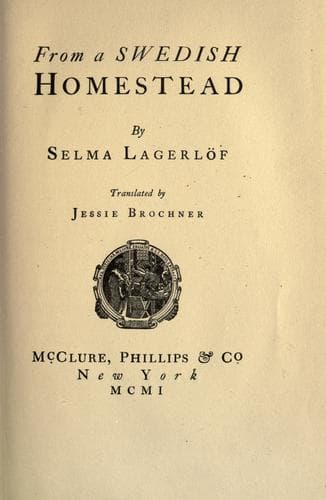
Short stories, Swedish -- Translations into English; Sweden -- Social life and customs -- Fiction
Perhaps he asks about the great oak on the Market Place, beneath which
the Kings sat in judgment, and where the twelve stones of judgment were
set up. Or about the long street, which was said to be seven miles long!
Or about the rich merchants' houses, separated by dark lanes, each
having its own landing-stage and boathouse down by the river. Or about
the Marie Church in the Market Place, where the seamen brought their
offerings of small, full-rigged ships, and the sorrowful, small silver
hearts.
But there is nothing left to show him of all these things. Cows and
sheep graze where the long street used to be. Rye and barley grow on the
Market Place, and stables and barns stand where people used to flock
round the tempting market-stalls.
How can he help feeling disappointed? Is there not a single thing to be
found, he says, not a single relic left? And he thinks perhaps that they
have been deceiving him. The great Kungahälla can never have stood here,
he says. It must have stood in some other place.
Then they take him down to the riverside, and show him a roughly-hewn
stone block, and they scrape away the silver-gray lichen, so that he can
see there are some figures hewn in the stone. He will not be able to
understand what they represent; they will be as incomprehensible to him
as the spots in the moon. But they will assure him that they represent a
ship and an elk, and that they were cut in the stone in the olden days
to commemorate the foundation of the city.
And should he still not be able to understand, they will tell him what
is the meaning of the inscription on the stone.
_The Forest_ QUEEN
Marcus Antonius Poppius was a Roman merchant of high standing. He traded
with distant lands; and from the harbour at Ostia he sent well-equipped
triremas to Spain, to Britain, and even to the north coast of Germany.
Fortune favoured him, and he amassed immense riches, which he hoped to
leave as an inheritance to his only son. Unfortunately, this only son
had not inherited his father's ability. This happens, unfortunately, all
the world over. A rich man's only son. Need one say more? It is, and
always will be, the same story.
One would almost think that the gods give rich men these incorrigible
idlers, these dull, pale, languid fools of sons, to show man what
unutterable folly it is to amass riches. When will the eyes of mankind
be opened? When will men listen to the warning voice of the gods?
Public-domain text, read in full here on John Shaqi.
Reviews
Reviews
No reviews yet
Be the first to share your thoughts on this work.
Elsewhere in the archive
Join the Discussion
Join the discussion
Sign in to leave a comment or review.
Sign InorCreate an account