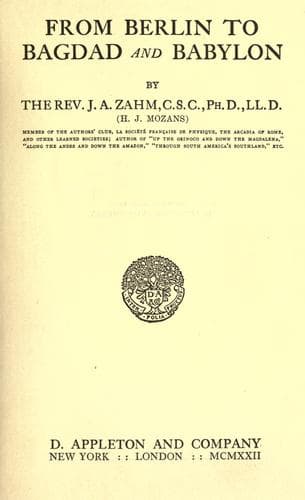
From Berlin to Bagdad and BabylonZahm, J. A. (John Augustine)
HistoryChristian
From Berlin to Bagdad and Babylon
Zahm, J. A. (John Augustine)
Middle East -- Civilization; Middle East -- Description and travel
Among these was the project of an Italian, Sig. A. Tonietti, who,
acting in behalf of a company of Italian and English financiers, sought
a concession for the construction of a line which should start from
Alexandretta on the Mediterranean and which, following the Euphrates
to Bagdad and Basra, should terminate at a point on the Persian Gulf.
He also sought a concession for building a number of branch lines,
one of which was to extend to Khanikin on the Persian frontier. In
addition to this he asked for authorization to cultivate the unoccupied
government lands along the course of the railroad during the term of
the concession. In return for this authorization he agreed to establish
an irrigation system which should restore the Euphrates valley to its
pristine fertility.
There was also a French group of financiers who, headed by M. Cottard,
a distinguished railroad engineer in Turkey, endeavored by all means
in their power to secure a concession for building a railway which was
to be a prolongation of the Anatolian line to Bagdad and Basra and to
follow essentially the same course along the Euphrates as the projected
road of Sig. Tonietti.
In addition to the two projects just mentioned was that of the Russian
Count Kapist, who proposed to build a line which should start from
Tripoli, in Syria, and, passing Bagdad, should terminate at Koweit
on the Persian Gulf. Count Kapist and his associates pretended that
they were assured of the eventual coöperation not only of English
capitalists but also of the British Government.[154]
The applicants for these divers concessions were, however, all doomed
to disappointment. Never before had so many, so antagonistic, and so
powerful interests made so long and so strenuous efforts to secure
the coveted privilege of building a railroad in foreign territory.
Never were diplomats more active in Constantinople, never was intrigue
more complicated, and never was greater pressure brought to bear
upon the Sublime Porte by the rival nations of Europe. France wished
to safeguard her interests in the Levant and extend her sphere of
influence in the Near East. Russia desired to tighten her hold on
Transcaucasia and to prepare for the eventual dismemberment of the
Turkish Empire of which she fondly hoped to secure the lion’s share.
England, although she had control of the Suez Canal, saw in the Bagdad
Railway a menace to her Indian possessions and determined to nullify
the danger before it was too late.
France had been on the friendliest terms with the Ottoman Government
since the time of Francis I and her financiers naturally felt that
the much coveted concession should be awarded to them as citizens of
the most favored nation. English capitalists put forward claims which
they regarded as deserving greater consideration than those of their
competitors.
Public-domain text, read in full here on John Shaqi.
Reviews
Reviews
No reviews yet
Be the first to share your thoughts on this work.
Elsewhere in the archive
Join the Discussion
Join the discussion
Sign in to leave a comment or review.
Sign InorCreate an account