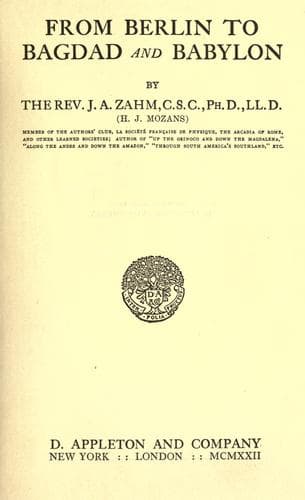
From Berlin to Bagdad and BabylonZahm, J. A. (John Augustine)
HistoryChristian
From Berlin to Bagdad and Babylon
Zahm, J. A. (John Augustine)
Middle East -- Civilization; Middle East -- Description and travel
Aside from the interest which attaches to it as the north-western
terminus of the Bagdad Railway, Konia, the ancient Iconium, like so
many other places in Anatolia, is extremely rich in legendary and
historic lore. According to a local myth it was the first spot to
emerge from the waters of the Deluge. It is mentioned in the legend
of Perseus and the Gorgons. A local legend has it that the name was
derived from the Greek word _eikon_--figure or image--referring to
the mud figures, which, when breathed upon by the wind, were converted
into living men and women. This is evidently a variant of the old myth
of Deucalion and Pyrrha. It was doubtless this pride in their great
antiquity and a belief that Phrygian was the primitive language of our
race that led the inhabitants of Iconium to claim a Phrygian origin.
That Phrygian was really the oldest language they had no doubt. For,
it was averred, the Egyptian King, Psametik, had conclusively proved
this by showing that “infants brought up out of hearing of human speech
spoke the Phrygian language.”
The Ten Thousand Greeks, in the army of Cyrus, halted here on their
famous expedition to southern Mesopotamia. Cicero reviewed his troops
here when he was proconsul of Cilicia. It was one of the important
missionary centers of the early evangelizing activity of St. Paul. It
was to this city that, accompanied by Barnabas, he directed his steps
after he had been expelled by the Jews from Antioch.
In Roman times Iconium stood at the intersection of several important
highways and was designated by Pliny _urbs celeberrima_--a most
celebrated city. According to a venerable tradition, Iconium had for
its first bishop Sosipatros, one of the seventy-two disciples, who was
succeeded in the episcopal chair by Terentius, likewise one of this
chosen body of disciples. Equally noteworthy is the fact that Iconium
was the birthplace of St. Thecla, who is said to have been converted
to Christianity by the Apostle St. Paul. She is the heroine of the
_Acta Pauli et Theclæ_. From the earliest ages of the Church
she was greatly venerated in Asia Minor, where she was known as the
“Apostle and Proto-martyr among Women.” In the Greek Church her feast
is celebrated on the twenty-fourth of September under the title of
“Proto-martyr among Women and the Equal of the Apostles.”
And here, according to a venerable tradition on which oriental
geographers set much store, is the tomb of “Plato the Divine,” who,
under the name of Eflat, is revered by the local population as a
thaumaturgus. The origin of this singular tradition in this part of
Anatolia--so distant from the real burying place of the immortal
philosopher--is one of the curiosities of Ottoman folklore.[178]
Public-domain text, read in full here on John Shaqi.
Reviews
Reviews
No reviews yet
Be the first to share your thoughts on this work.
Elsewhere in the archive
Join the Discussion
Join the discussion
Sign in to leave a comment or review.
Sign InorCreate an account