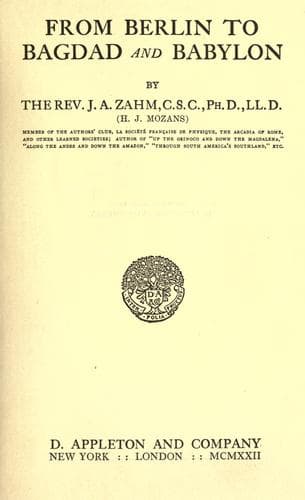
From Berlin to Bagdad and BabylonZahm, J. A. (John Augustine)
HistoryChristian
From Berlin to Bagdad and Babylon
Zahm, J. A. (John Augustine)
Middle East -- Civilization; Middle East -- Description and travel
CHAPTER IX
IN HISTORIC CILICIA CAMPESTRIS
_Domes, minarets, their spiry heads that rear,_
_Mocking with gaudy hues the ruins near;_
_Dim crumbling colonnades and marble walls,_
_Rich columns, broken statutes, roofless halls;_
_Beauty, deformity, together thrown,_
_A maze of ruins, date, design unknown--_
_Such is the scene, the conquest Time hath won._
NICOLAS MICHEL.
It is doubtful whether, in any part of the world, more history has been
condensed in less area than in the picturesque region formerly called
Cilicia. Roughly speaking, it comprised the triangle bordered by the
Mediterranean and the lofty ranges of the Taurus and Amanus Mountains.
Its rich alluvial plains, watered by the celebrated Cydnus and Pyramus,
Sarus, and Pinarus, early attracted a large population, who found there
not only a mild and serene climate but also a soil that yielded in
rare abundance the plants and fruits most useful to their sustenance
and comfort. But, although the economical value of the Cilician
Plain--called by Strabo _Cilicia Campestris_--was great, it was
rather the political and military importance of this country that made
it the prize of contending nations from the earliest dawn of history.
In the days when Hittite and Assyrian fiercely contended for universal
empire--long
_Ere Rome was built or smiled fair Athen’s charms_
it was the highway between Asia Minor and Mesopotamia. It was the
royal road between Persia and Greece on which was heard the martial
tread of the armies of Xerxes, Cyrus, and Alexander. Rameses II--the
Napoleon of Egypt--and Asurbanipal--the Napoleon of Assyria--led
their victorious hosts along this road and, like the warriors who
had preceded them, found subsistence for their men in the fertile
valleys of the Pyramus and the Cydnus. It was also a field of frequent
sanguinary conflicts during the days of Pompey and Cicero, of Mark
Anthony and Zenobia, the rarely gifted but ill-fated “Queen of the
East.” It was a continued arena of strife during protracted wars
between the Byzantine Emperors and the Sassanian Kings, between the
Osmanlis and Timur and Jenghiz Khan, and, in recent times, between the
Sultan of Constantinople and his ambitious and rebellious viceroy,
Ibrahim Pasha of Egypt.
Public-domain text, read in full here on John Shaqi.
Reviews
Reviews
No reviews yet
Be the first to share your thoughts on this work.
Elsewhere in the archive
Join the Discussion
Join the discussion
Sign in to leave a comment or review.
Sign InorCreate an account