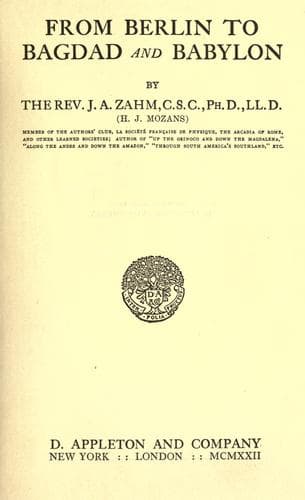
From Berlin to Bagdad and BabylonZahm, J. A. (John Augustine)
HistoryChristian
From Berlin to Bagdad and Babylon
Zahm, J. A. (John Augustine)
Middle East -- Civilization; Middle East -- Description and travel
This indiscriminate destruction of centers of culture and marts of
commerce is often attributed to the Turks. But, as we have already
seen, the Turks--I refer especially to the Osmanlis--who have been the
rulers of the Ottoman Empire for more than five hundred years, were
not like the Mongols and Tartars, a nation of raiders, but a nation of
colonizers and empire builders. Their object, therefore, was not to
destroy but to construct and develop. Those who make this charge, which
is in great measure gratuitous, forget the wholesale destruction of
the hordes of Timur and Jenghiz Khan, not to speak of other raiders,
and lose sight of the fact that some of the most famous cities of the
East were reduced to ashes by the armies of Greece and Rome more than
a thousand years before the appearance of the armies of the Ottoman
conquerors in Syria, Greece, and Ionia. Thus, to mention only a few
instances, it was Alexander the Great who destroyed Halicarnasus,
the birthplace of the historians Herodotus and Dionysius. Here stood
the magnificent tomb of Mausolus, classed by the ancients among the
seven wonders of the world, the ruins of which were in 1402 used by
the Knights of St. John of Jerusalem as a quarry for building their
castles. It was the Roman general Mummius who brought ruin to the
famous city of Corinth. This was, in truth, rebuilt by Julius Cæsar,
but only to be destroyed again, at a much later period, by the Greeks
themselves. It was the Emperor Aurelian who doomed to destruction
Palmyra, the magnificent capital of Zenobia, almost during the heyday
of its architectural splendor and commercial prosperity. It was the
Goths who demolished the temple of Diana at Ephesus, another of the
world’s wonders, while the city itself was in ruins even before the
advent of the devastating Timur. But it was Timur who razed Sardis, the
capital of Crœsus, whose name has ever been a synonym of untold wealth.
It was Malik al-Ashraf, ruler of Egypt and Syria, who destroyed the
famed city of Tyre after its long and eventful history which antedated
the reigns of Hiram and Solomon.
Public-domain text, read in full here on John Shaqi.
Reviews
Reviews
No reviews yet
Be the first to share your thoughts on this work.
Elsewhere in the archive
Join the Discussion
Join the discussion
Sign in to leave a comment or review.
Sign InorCreate an account