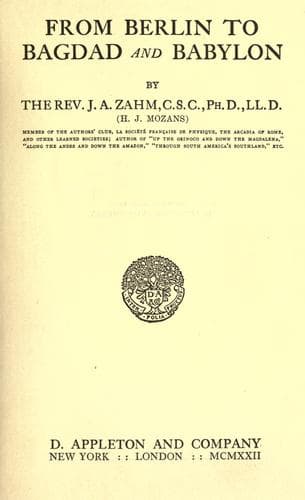
From Berlin to Bagdad and BabylonZahm, J. A. (John Augustine)
HistoryChristian
From Berlin to Bagdad and Babylon
Zahm, J. A. (John Augustine)
Middle East -- Civilization; Middle East -- Description and travel
If it were a question of the inhabitants of Central Africa, who were
practically unknown until the explorations of Speke, Stanley, and
Livingstone, we should not be surprised that even geographers should
know next to nothing about them. But it seems difficult to explain the
widespread ignorance which has everywhere obtained regarding a people
who have played so important a rôle in history as the Moslems, and who
during more than twelve centuries have been in constant relations with
the Christian nations of Europe.
But, although the contact between the East and the West has been
uninterrupted since the time Moslemism essayed
_To plant the Crescent o’er the Cross_,
the misrepresentations of Mohammed and his followers have continued
without intermission from the days of the Crusaders to the present
time. And the strangest thing is that the most extravagant tales about
Mohammedans and their religion were put in circulation when their
originators must have known that they had no foundation in fact.
Many of the stories--as false as they were ridiculous--that were long
current respecting the Arabian Prophet and the religion which he
founded were due to the _Trouvères_ and the _Troubadours_.
A great majority of the _Chansons de Geste_ exhibit a pitiful
ignorance of the tenets of the Saracens, and not a few of them
contributed to give vogue to the most revolting fables respecting
Mohammed and Islam. Although neither Leo the Isaurian nor Oliver
Cromwell, both the sworn enemies of images, were more opposed to
idolatry or to the worship of images than Mohammed, nevertheless, in
_La Chanson de Roland_,[230] the Franks are represented under
the walls of Saragossa as avenging their defeat at Roncesvelles by
mutilating and destroying the idols of their enemies.
In the _Chanson d’Antioche_--declared to be “a very beautiful
_chanson_ which does not contain any fables but only the
unadulterated truth”--the author, Richard le Pelerin, in the beginning
of his poem, asks God to put to dire confusion the followers of
Mohammed--especially those
_Qui croient et adorent la figure Mahom._
In the _Roman de Beaudouin de Sebourc_, the author goes to still
greater lengths. By a strange aberration he makes the idol of Mohammed
the emblem of Islam, as the Cross is the emblem of Christianity. For,
in this _chanson_ the Comtesse de Porthieu is represented as
wishing to abjure her faith before the Sultan Saladin and expressing
her readiness to adore the effigy of the Prophet:
_Mahom voel aourer; aportez-le-moi-cha._
And Saladin, on his part, is pictured as ordering the idol to be
brought for the adoration of the newly made convert to Mohammedanism:
_Qu’ on aportast Mahom, et celle l’aoura._
Public-domain text, read in full here on John Shaqi.
Reviews
Reviews
No reviews yet
Be the first to share your thoughts on this work.
Elsewhere in the archive
Join the Discussion
Join the discussion
Sign in to leave a comment or review.
Sign InorCreate an account