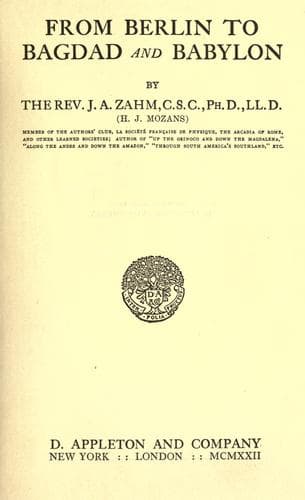
From Berlin to Bagdad and BabylonZahm, J. A. (John Augustine)
HistoryChristian
From Berlin to Bagdad and Babylon
Zahm, J. A. (John Augustine)
Middle East -- Civilization; Middle East -- Description and travel
As a proof of this assertion, I need only adduce the beautiful prayer
of the Persian imam, El Kachiri, who, discarding the cold and formal
acts of praise prescribed in Moslem worship, pours forth his soul to
God in these touching and heart-felt words:
Thou, O Lord, threatenest me, with a bitter separation which
will forever deprive me of Thy presence! O Lord, do with me as
Thou wilt, provided that I be not forever separated from Thee!
There is no more bitter nor fatal poison than this separation.
For what can a soul separated from God do except be in a state
of inquietude and agitation which will be a continual torment?
One would rather suffer a hundred thousand deaths; for, after
all, they would not offer anything so terrible as the privation
of the vision of Thy divine face. All the evils of the world,
all the most acute and painful diseases joined together, seem
to me incomparably easier to bear than this removal from Thee.
It is this transitory removal which renders our lands sterile;
which dries up and infects our waters. What would it be if it
were eternal? Without it, the fire of hell would not burn; it
is through it that it becomes so hot. In a word, it is only Thy
presence which sustains us and showers upon us all kinds of good
things and Thy absence, it is, which causes all the evils of
hell.[251]
This prayer is fully in keeping with the teaching of many other Moslem
mystics of non-Semitic origin, who, contrary to the vulgar notions
so widely entertained respecting the Mohammedan paradise, explicitly
declare that the infinite happiness of the elect in heaven consists
in the enjoyment of the beatific vision. This ineffable happiness,
they aver, so far transcends all the other joys of paradise that they
completely disappear before it. “Paradise, O Lord,” exclaims the Sheik
el Alem, “is desirable only because one there sees Thee; because,
without the light of Thy beauty, it would pall on us.”[252]
These two quotations are remarkable but no less so than the words of a
Mussulman poet of Persia who, in addressing himself to Isa--Arabic for
Jesus--says:
The heart of the afflicted man draws all his consolation from
Thy words. The soul resumes life and vigor simply by hearing Thy
name pronounced. If the mind of man is ever able to raise itself
to the contemplation of the mysteries of the Divinity, it is
from Thee that it draws the light to know them and it is Thou
that givest him the attraction by which he is penetrated.[253]
How like the language of a Christian speaking of the grace of our
Saviour, Jesus Christ!
Public-domain text, read in full here on John Shaqi.
Reviews
Reviews
No reviews yet
Be the first to share your thoughts on this work.
Elsewhere in the archive
Join the Discussion
Join the discussion
Sign in to leave a comment or review.
Sign InorCreate an account