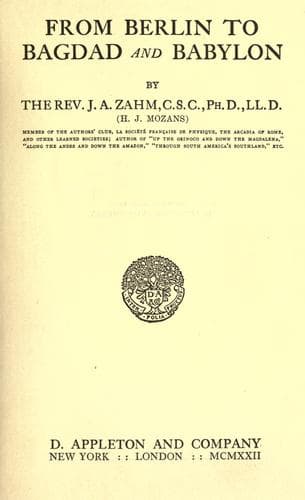
From Berlin to Bagdad and BabylonZahm, J. A. (John Augustine)
HistoryChristian
From Berlin to Bagdad and Babylon
Zahm, J. A. (John Augustine)
Middle East -- Civilization; Middle East -- Description and travel
In the preceding pages I have endeavored in the limited space available
to give an honest statement regarding the actual tenets and status of
Moslemism in the past as well as in the present. While, on the one
hand, I have studiously eschewed everything like detraction, I have,
on the other, as carefully avoided anything that could reasonably be
construed as an apology either for Mohammed or for Mohammedanism.
It has never entered my mind, God forbid! to compare Moslemism with
Christianity as a means for attaining to a true knowledge of our
Creator or for realizing the highest spiritual ideals of which our
race is capable. No, Christianity, especially that form of it which
has sanctified and crowned the lives of a St. Jerome, a St. Francis of
Assisi, a St. Theresa, a Joan of Arc; which presided at the sublime
meditations of an Augustine of Hippo, or a Thomas of Aquin, of a Dante
Alighieri, of a Christopher Columbus; which has given to the world such
matchless heroes and heroines of charity and self-sacrifice as a St.
Vincent de Paul, a Father Damien, a Sister of Charity, or a Little
Sister of the Poor; that for us is the truest, the holiest, the most
beneficent of all religions; the one that contains in all its fullness
the revealed word of God, the one which must be our guide to a world of
happiness eternal in the life beyond the tomb.
Truth and justice, however, compel us to admit that there are many,
very many, things in Islam to extort our admiration. Nor can there be
any doubt that Mohammed achieved many things for the improvement of his
idolatrous, drink-sodden, vice-steeped, feud-wrecked countrymen. The
Koran, we must confess, contains many beautiful things regarding one’s
duties towards God and one’s neighbor; but all of them are directly
or indirectly derived from the New or the Old Testament, or from the
doctrines of the early Church. Notwithstanding all this, however, the
teachings of Islam are as far beneath the saving and incomparable
truths of Christianity as is the gross and sensual Prophet of Mecca
beneath the all-pure and all-perfect Son of God.
But, to recur again to the previously quoted opinion of Cardinal
Hergenrœther, Islam can serve as a stepping-stone from fetishism
to Christianity and as such is worthy of our sympathetic study and
appreciation.
Public-domain text, read in full here on John Shaqi.
Reviews
Reviews
No reviews yet
Be the first to share your thoughts on this work.
Elsewhere in the archive
Join the Discussion
Join the discussion
Sign in to leave a comment or review.
Sign InorCreate an account