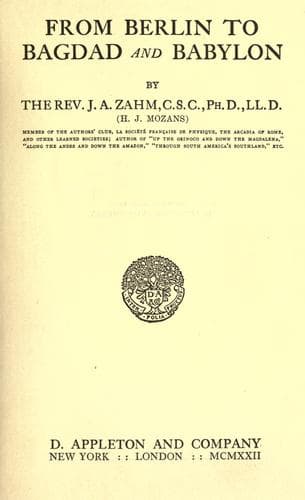
From Berlin to Bagdad and BabylonZahm, J. A. (John Augustine)
HistoryChristian
From Berlin to Bagdad and Babylon
Zahm, J. A. (John Augustine)
Middle East -- Civilization; Middle East -- Description and travel
There is, however, a great difference between the two cities. Jerusalem
is a city of sacred monuments and holy memories while Aleppo is noted
as Syria’s busiest interior mart. At present its population is about
one hundred and thirty thousand but in the heyday of its prosperity it
counted no fewer than three hundred thousand souls. It was then the
great _entrepôt_ of trade between the Orient and the Occident.
Then great caravans brought silks from China, carpets and tapestry from
Persia, spices, drugs, pearls, and precious stones from India and the
Spice Islands of the Malay Archipelago. It was then headquarters for a
large colony of Venetian, Dutch, French, and English merchants who here
exchanged the products of the West for the prized merchandise of the
East.
Pietro della Valle, the distinguished Roman traveler who visited Aleppo
in 616, was immensely impressed by the magnitude of its commercial
transactions. So great was the amount of money involved that, he
says, it was never counted but always weighed in boxes. And no one,
he assures us, ever spoke of sales or purchases that did not amount
to sums which ranged, at the lowest, from forty to a hundred thousand
scudi.[269]
For a long time Aleppo was one of the chief trade centers in the
East of the Levant and East India companies. During the period of
their greatest prosperity the amount of business transacted here
was enormous. For, in addition to these two great organizations, the
British Factory here counted no fewer than eighty firms, besides
which all the leading countries of Europe had here their factories or
organizations of factors or agents for the purpose of securing their
share of the great trade of the Orient.
At that time a great part of the commerce of the Far East came to
Aleppo by way of Basra and Bagdad. Then the population of Basra
exceeded two hundred thousand whereas it does not now count more
than one-fourth of that number. The number of Bagdad’s inhabitants
has diminished in proportion. The great decrease in the commercial
importance of these two cities was partly due to war and pestilence.
But the great discovery by Vasco da Gama of an all-sea route between
the West and the East and the opening of the Suez Canal reduced the
overland traffic between the Mediterranean and the Persian Gulf to a
small fraction of what it was in the palmy days of the great European
factories of Aleppo, Basra, and Bagdad. According to the plans of its
projectors, the Bagdad Railway is to restore this overland trade to its
former magnitude and even greatly add to its amount and value.
Public-domain text, read in full here on John Shaqi.
Reviews
Reviews
No reviews yet
Be the first to share your thoughts on this work.
Elsewhere in the archive
Join the Discussion
Join the discussion
Sign in to leave a comment or review.
Sign InorCreate an account