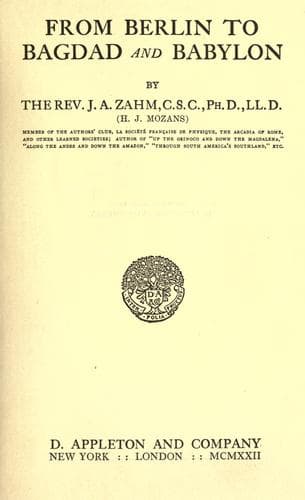
From Berlin to Bagdad and BabylonZahm, J. A. (John Augustine)
HistoryChristian
From Berlin to Bagdad and Babylon
Zahm, J. A. (John Augustine)
Middle East -- Civilization; Middle East -- Description and travel
I found an additional interest here in the reflection that Aleppo is on
the linguistic frontier--extending from Alexandretta to Biredjik on the
Euphrates--which separate the peoples of the flowery Arabic speech from
those of the more laconic but no less vigorous Turkish. South of this
line Turkish ceases to be heard except in the offices of the civil and
military administrations of the Ottoman government.
The Syrians, like the Arabs, are Semites, but of their ancient tongue,
the Aramaic, little now remains except a sort of dialect which is
now confined to only a few villages on the eastern declivities of
the Anti-Libanus.[282] Syriac, it is true, is still the liturgical
tongue of the Maronites and Jacobites as it was for centuries that of
other oriental Christians of Semitic origin. But, if a small number
of priests still understand Syriac, no one any longer speaks it. For
Syrians as well as for Arabs the language of conversation has for a
long time been the vulgar Arabic. The Christians, however, speak a less
pure form than the Moslems, for the adherents of Mohammed, by their
constant reading of the Koran, become familiar with the more literary
forms of classical Arabic.
During the Seleucid and Byzantine domination, the predominant language
of educated people in Syria and Asia Minor was Greek. But in these, as
well as in other regions formerly belonging to the Ottoman Empire, we
now find the most extraordinary anomalies of linguistic distribution.
Thus there are in Anatolia villages whose sole inhabitants are Greeks
who belong to the Orthodox Church and where the Greek language is so
little understood that the priests, in order to be understood by their
people, are obliged to preach and read the services of the church in
Turkish. In Cyprus, on the contrary, there are Turkish villages whose
inhabitants speak only Greek. But this is no more singular than to
find--a frequent occurrence--Turkish newspapers printed in Greek or
Armenian characters. These literary curiosities are, however, eclipsed
by a Jewish newspaper in Constantinople which is printed in Hebrew
characters although the language is Spanish.[283]
Public-domain text, read in full here on John Shaqi.
Reviews
Reviews
No reviews yet
Be the first to share your thoughts on this work.
Elsewhere in the archive
Join the Discussion
Join the discussion
Sign in to leave a comment or review.
Sign InorCreate an account