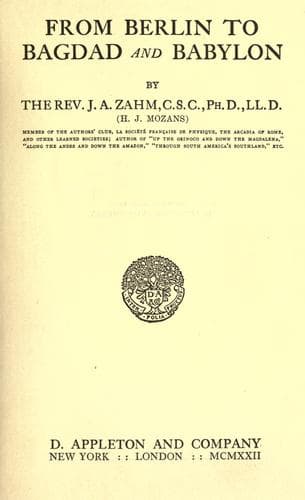
From Berlin to Bagdad and BabylonZahm, J. A. (John Augustine)
HistoryChristian
From Berlin to Bagdad and Babylon
Zahm, J. A. (John Augustine)
Middle East -- Civilization; Middle East -- Description and travel
But “The River,” “The Great River,” as the Jews called the Euphrates,
was more celebrated in profane than in sacred history. This is
particularly true of that stretch of the stream between the modern
towns of Bir and Rakka. It was at Carchemish, which adjoins Djerabis,
where the Hittites had the great capital and the powerful fortress
which enabled them so long to control the commerce between Assyria and
Babylonia on the east, and Phœnicia and Egypt on the west. It was at
the same famous stronghold that Nebuchadnezzar II won a signal victory
over Pharaoh-Necho and his Greek and Asiatic allies. It was here also
that Chosroes I crossed the river by building a bridge of boats at the
time of his third campaign against the Byzantines as he had crossed it
at Obbanes in his first expedition against Justinian. It was at Bir,
formerly known as Zeugma--the Bridge--that Crassus and Seleucus Nicator
passed into Mesopotamia, where the Roman general met such a tragic
fate. It was at Thapsacus that Xenophon and Cyrus the Younger crossed
the great waterway in the campaign that terminated so disastrously for
the Persian Monarch at Cunaxa. It was here also, nearly a hundred years
later, that Darius crossed “fleeing headlong eastwards with his broken
army after the battle of Issus, with Alexander headlong at his heels.”
It was in the waters of the same famed river that Trajan and Julian
the Apostate slaked their horses’ thirst. It was the same waters that
witnessed the brilliant campaigns of Heraclius, the splendid triumphs
of the Caliphs, and the devastating hordes of Timur and Jenghiz Khan.
Tradition informs us that it was down these tawny waters that a frail
craft carried Herodotus in his memorable visit to Babylon. And long
before this date it was up the Euphrates, that Gisdhubar, the mythical
hero of the great Babylonian epic, proceeded on his homeward voyage
after having “by a suitable sacrifice,” secured the good will of heaven
for his undertaking.[296] But, what has already been said is more than
enough to show that the rolling waters of the Euphrates are, in truth,
“charged with the history of the ancient world.” And, judging by the
railroads and steamer lines that are planned or in operation, and the
great irrigation works that are under construction for restoring to
the vast Babylonian plain its old-time fertility, the day is not far
distant when “The Great River” of the Jews will witness achievements
which shall rival the glories of Babylon and its hanging gardens in the
days of the city’s greatest splendor and power.
Public-domain text, read in full here on John Shaqi.
Reviews
Reviews
No reviews yet
Be the first to share your thoughts on this work.
Elsewhere in the archive
Join the Discussion
Join the discussion
Sign in to leave a comment or review.
Sign InorCreate an account