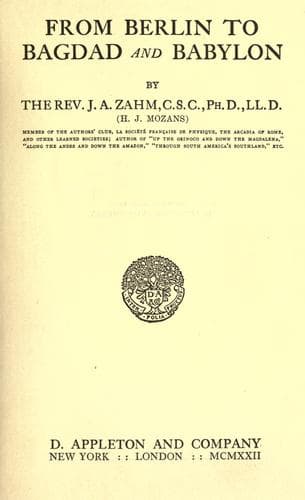
From Berlin to Bagdad and BabylonZahm, J. A. (John Augustine)
HistoryChristian
From Berlin to Bagdad and Babylon
Zahm, J. A. (John Augustine)
Middle East -- Civilization; Middle East -- Description and travel
Like all travelers we visited the city’s chief lion--the great
reservoir which, as Pliny informs us, won for Edessa the name
Callirhoe--the city of the beautiful well--spring--_Callirhoen a
fonte nominatam_. From the earliest days to the present, this
reservoir has been held in great veneration. In pagan times it was
consecrated to the goddess Athagartis. To-day it is known as the Pool
of Abraham. The large number of fish with which it is always filled
are sacred in the eyes of the Mohammedans, who consider it a very
meritorious act to supply them with nourishment. The groups that are
sometimes gathered around this pool feeding the sacred fish seem quite
as preoccupied as the crowds that so generously distribute their
supplies of grain to the pampered pigeons of San Marco, Venice.
The only ecclesiastics in Urfa to-day to devote themselves to the work
of the Church which St. Ephrem and his associates served so well, whose
convent was our home during our visit to their famous city, are the
Capuchins. It is now more than two and a half centuries since these
zealous sons of St. Francis inaugurated their missionary labors in
Mesopotamia and the adjoining countries, and these have been centuries
of trial and sacrifice and persecution which would have forced less
heroic men to abandon an undertaking that often seemed impossible.
Everywhere they were confronted by the fanaticism of Mohammedanism,
which was naturally suspicious, and the jealousy of schism and heresy
which were quick to take umbrage at whatever was calculated in any way
to affect their age-long belief and practices.
During hundreds of years the torch of the faith which St. Ephrem had
preached had been extinct in the broad region which the Capuchins
had chosen for the field of their missionary activity. And during an
almost equally long period, all vestige of union between the churches
of Mesopotamia and those of the adjacent regions had completely
disappeared.
Public-domain text, read in full here on John Shaqi.
Reviews
Reviews
No reviews yet
Be the first to share your thoughts on this work.
Elsewhere in the archive
Join the Discussion
Join the discussion
Sign in to leave a comment or review.
Sign InorCreate an account