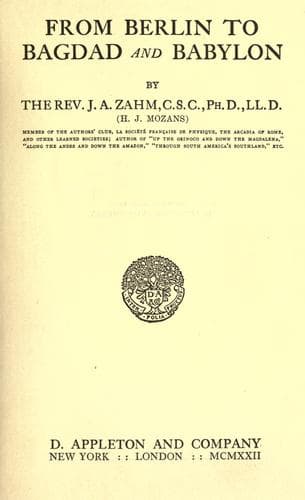
From Berlin to Bagdad and BabylonZahm, J. A. (John Augustine)
HistoryChristian
From Berlin to Bagdad and Babylon
Zahm, J. A. (John Augustine)
Middle East -- Civilization; Middle East -- Description and travel
Nothing, however, was so calculated to stir up the rancor of the Greeks
against the Latins as the Pope’s coronation of Charlemagne as Emperor
of territory that was regarded as an integral part of the Byzantine
Empire. For the Greeks then held the theory, which was subsequently
so elaborated by Dante in his _De Monarchia_, that the cause of
Cæsar was the cause of Christ and that the perfection of the Church
presupposed the integrity of the Empire and harmonious relations
between Pope and Emperor. When, therefore, the Roman Patriarch set up
a rival Augustus in the person of Charlemagne and divided the Roman
Empire, which, under Justinian, extended from the Euphrates to the
Pillars of Hercules, he was in the estimation of the Byzantines guilty
of high treason. Claiming that they alone had the direct line of
imperial continuity they would never recognize Charlemagne as anything
more than “a barbarian King of a barbarian people.”[337] To what extent
the establishment of the Empire in the West contributed to existing
friction and to the fatal rupture between New Rome and Old Rome, which
occurred seventy years later, is a matter of speculation, but it can
scarcely be doubted that its effect on the exacerbated temper of the
Greeks was far greater than is usually imagined.
Although, during the first five centuries of its existence, the See of
Constantinople had several times been out of communion with Rome, the
“Great Schism,” as it is called, was not inaugurated until Photius,
with the connivance of the Byzantine Emperor, iniquitously usurped
the Patriarchate of New Rome. After the death of this intruder in 891
peace was again restored between the Eastern and Western Churches.
But the schism that had been engendered by the misunderstandings
and animosities, jealousies and ambitions, of centuries was healed
only temporarily. For but a little more than a century and a half
had elapsed after the mortal remains of Photius--who has been called
“the Luther of the Orthodox Church”--had been moldering in an unknown
grave when the Byzantine Church was again, in 1050, thrown into schism
by the overweening ambition of Michael Cerularius, whom the Emperor
Constantine IX had, in violation of the most sacred laws of the
Church, foisted into the See of Constantinople as its Patriarch.
Public-domain text, read in full here on John Shaqi.
Reviews
Reviews
No reviews yet
Be the first to share your thoughts on this work.
Elsewhere in the archive
Join the Discussion
Join the discussion
Sign in to leave a comment or review.
Sign InorCreate an account