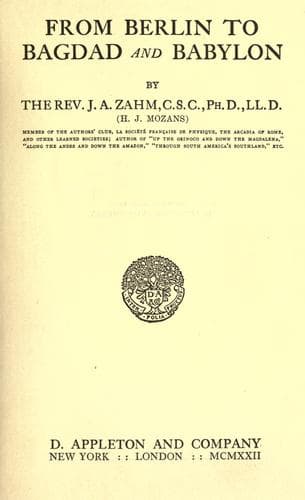
From Berlin to Bagdad and BabylonZahm, J. A. (John Augustine)
HistoryChristian
From Berlin to Bagdad and Babylon
Zahm, J. A. (John Augustine)
Middle East -- Civilization; Middle East -- Description and travel
Nature has given me the body of a woman but my achievements
have made me the equal of the most valiant of men. I have ruled
the empire of Ninus which on the east extends to the river
Hinamanes, on the south to the country of incense and myrrh,
and on the north as far as the Sacæ and the land of Sogdiana.
Before me no Assyrian had seen any of the seas; I have seen
four of them which were so distant that no one had ever reached
them. I have forced rivers to flow where I wished them to, and
I have wished them to flow only where they would be useful.
I have rendered the sterile earth fecund by irrigating them
with these rivers. I have erected impregnable fortresses.
With iron I have made roads through impassable rocks. I have
constructed for my chariots highways through places which the
wild beasts themselves had never traversed. And in the midst of
these occupations I have found time for my amusements and my
pleasures.[392]
Zenobia and Cleopatra were distinguished for their beauty, their
genius, and the brilliancy of their achievements, but, according to the
testimony of Ctesias, Diodorus Siculus, and other ancient historians,
they were completely eclipsed by the wonder-working queen of Assyria.
So great, tradition had it, were her abilities as a sovereign that two
thousand years after her time the most eminent female rulers of their
age were named after this extraordinary woman who had so impressed
her personality on the West as well as on the East. Thus it is that
Catherine II of Russia, who was almost the rival of Peter the Great, is
known as the Semiramis of the North, while the same epithet is given
to that remarkable sovereign, Queen Margaret de Valdemar of Norway,
Sweden, and Denmark.
But when, in the second half of the last century, Orientalists began
to decipher the cuneiform inscriptions of Western Asia, the majority
of them soon showed a marked skepticism regarding the historical
character of the renowned Assyrian queen. It was contended that there
was no mention of her name in the Babylonian records during the period
in which she was supposed to have lived and that the silence of these
records respecting a ruler who, according to ancient writers, played
so important a rôle in antiquity was conclusive proof that she never
existed. It was furthermore asseverated that the work of Ctesias,
which for so many centuries had been accepted as sober history, was no
more than a romantic narrative which the progress of Assyrian research
had completely discredited. And Semiramis, it was further averred,
was not a woman of flesh and blood at all but an entirely mythical
character,--merely a creation of Ctesias and having no existence
outside of his elaborate romance which for more than two thousand years
passed as serious history.
Public-domain text, read in full here on John Shaqi.
Reviews
Reviews
No reviews yet
Be the first to share your thoughts on this work.
Elsewhere in the archive
Join the Discussion
Join the discussion
Sign in to leave a comment or review.
Sign InorCreate an account