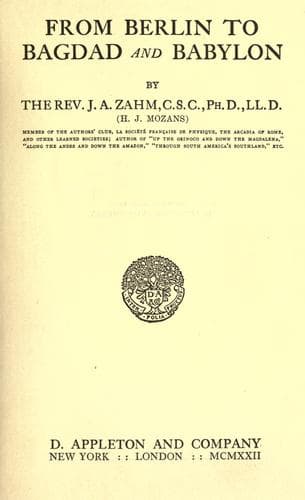
From Berlin to Bagdad and BabylonZahm, J. A. (John Augustine)
HistoryChristian
From Berlin to Bagdad and Babylon
Zahm, J. A. (John Augustine)
Middle East -- Civilization; Middle East -- Description and travel
It will interest the reader to know that the study of French is
obligatory from the lowest to the highest classes of the school. The
result is that many of the pupils speak the language with wonderful
facility and correctness. At the commencement exercises at the end of
the year they exhibit their proficiency before a large audience made
up of the élite of the city by giving a play from Racine. It is in
consequence of their thorough knowledge of the language of Molière and
Bossuet that after leaving school they are given high positions in
the leading houses of commerce and in all the administrative offices
of the government. The traveler is often surprised at the extent
to which French is spoken in the Near East; but when one remembers
that the schools and colleges in the Ottoman Empire, which are under
the direction of French priests, sisters, and laymen are numbered
by the thousand, the wonder ceases. It is for this reason that the
empire is, in the words of Pierre Loti--_presque un pays de langue
française_--almost a country of the French language.[424]
The missionaries in Bagdad--from the Archbishop down to the humblest
nun--are greatly attached to the city in which Divine Providence has
called them to labor and--to suffer. Not the least reason for this
attachment is the glorious position which Bagdad so long occupied in
the history of the world. Until the late war the average reader knew
little about it except that it was in some way associated with the
“Arabian Nights.” And this association was so vague in his mind that he
was not sure whether Bagdad ever had an actual existence or whether it,
like the famous characters in _Thousand and One Nights_, belonged
only to fable land.
For this reason it seems this chapter would be incomplete without some
account of the famous city which, during five hundred years, was the
capital of the Abbasside Caliphs; which, there is reason to believe,
was for a considerable period the largest city in the world; which,
during many centuries bore rule from the Oxus to the Nile and from the
Caucasus to the Gulf of Oman; and which, during a half millennium, was
to Islam what Rome is to Christendom.
Public-domain text, read in full here on John Shaqi.
Reviews
Reviews
No reviews yet
Be the first to share your thoughts on this work.
Elsewhere in the archive
Join the Discussion
Join the discussion
Sign in to leave a comment or review.
Sign InorCreate an account