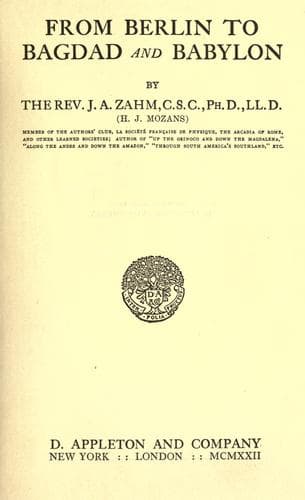
From Berlin to Bagdad and BabylonZahm, J. A. (John Augustine)
HistoryChristian
From Berlin to Bagdad and Babylon
Zahm, J. A. (John Augustine)
Middle East -- Civilization; Middle East -- Description and travel
But no description of Bagdad is complete without some account of its
more eminent Caliphs, especially of its immortal Harun-Al-Rashid, who
is “inseparably associated with the most charming collection of stories
ever invented for the solace and delight of mankind.” This brilliant
Saracen ruler has long been ranked among the illustrious men of all
time. For, notwithstanding the fact that from time immemorial legends
have gathered around his name in greater number than about those of
King Arthur, or Charlemagne, or Frederick Barbarossa, authentic history
tells us enough of his character and achievements to make the romantic
life of “Aaron the Just”--to Anglicize his name--one of supreme
fascination and abiding interest.
The Arabians [Sismondi writes] are indebted to him for the
rapid progress which they made in science and literature, for
Harun never built a mosque without attaching to it a school.
His successors followed his example, and in a short period the
sciences which were cultivated in the capital spread themselves
to the very extremities of the empire of the Caliphs. Whenever
the faithful assembled to adore the Divinity, they found in this
temple an opportunity of rendering Him the noblest homage which
His creatures can pay--by the cultivation of those faculties
with which their Creator has endowed them. Harun-Al-Rashid,
besides, was sufficiently superior to the fanaticism which
had previously animated his sect not to despise the knowledge
which the professors of another faith possessed. The head of
his schools and the first director of studies in his empire
was a Nestorian Christian of Damascus, of the name of John Ebn
Mesua.[436]
Christians were the translators of the works of Plato and Aristotle; of
Galen, Hippocrates, and Dioscorides; of Ptolemy, Euclid, and Apollonius
Pergæus.
No Caliph ever gathered round him so great a number of learned
men:--poets, jurists, grammarians, cadis and scribes,--to say
nothing of the wits and musicians who enjoyed his patronage.
Personally, too, he had every quality that could recommend
him to the literary men of his time. Harun himself was an
accomplished scholar and an excellent poet; he was well versed
in history, tradition and poetry which he could always quote on
appropriate occasions. He possessed exquisite literary taste
and unerring discernment and his dignified demeanor made him an
object of profound respect to high and low.[437]
He was, indeed, as described by his biographers, “the most
accomplished, eloquent and generous of the Caliphs,” and the stories
that are told of his lavish generosity towards scholars who frequented
his court proved that he was probably the most munificent patron of men
of science and letters that ever lived.
Public-domain text, read in full here on John Shaqi.
Reviews
Reviews
No reviews yet
Be the first to share your thoughts on this work.
Elsewhere in the archive
Join the Discussion
Join the discussion
Sign in to leave a comment or review.
Sign InorCreate an account