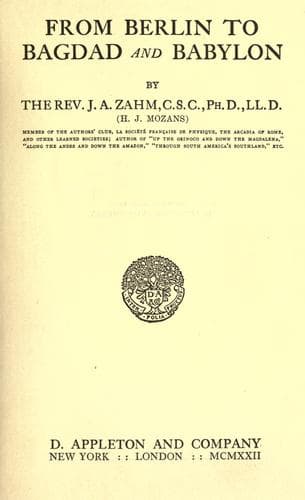
From Berlin to Bagdad and BabylonZahm, J. A. (John Augustine)
HistoryChristian
From Berlin to Bagdad and Babylon
Zahm, J. A. (John Augustine)
Middle East -- Civilization; Middle East -- Description and travel
Almost within a stone’s throw of where I stood was the Golden Horn
sprinkled with hundreds of delicate, pointed caiques and bearing on
its sapphire bosom ships of all sizes and flying the flags of all
nations. It was up this famous stream that Byzas, the reputed son of
Neptune, steered his frail craft nearly seven centuries before our
era. And it was on the southern bank of this sheltered haven that the
daring navigator, with his doughty Megarans, laid the foundation of
Byzantium--named after himself--which was to play such a remarkable
rôle in the world’s great drama.
A thousand years later--almost to a day--Constantine the Great abandons
the city of Romulus and selects that of Byzas as the capital of the
great Roman empire. On foot, with a lance in hand, the Emperor leads
a solemn procession, and, under divine command--_jubente Deo_,
as he phrased it--traces the boundary of the future metropolis. His
assistants, astonished at the over-growing circumference of the
destined capital, ventured to observe that the contemplated area of a
great city had already been exceeded. “I shall continue to advance,”
replied the Emperor, “until the Invisible Guide who precedes me bids me
halt.”
It was across the Golden Horn that “blind old Dandolo”--that
marvelous doge of ninety-seven years--led the Venetian forces against
Constantinople and awakened the degenerate Greeks from “a dream of nine
centuries--from the vain presumption that the capital of the Roman
Empire was impregnable to foreign arms.” The marble mausoleum of this
remarkable man--whose physical and mental powers were vigorous to the
last--occupied a place in Santa Sophia until it was transformed into a
mosque, and, even to-day, one may see in one of the galleries of the
venerable fane a marble slab bearing in almost illegible characters the
name of Henricus Dandolo.
And it was across the Golden Horn that Mohammed II passed when he
entered the breached walls through New Rome as conqueror. But he was
not able to effect an entrance into the ill-fated city without passing
over the lifeless body of its noble defender, the valiant Constantine
Paleologus, the last of the Byzantine Cæsars.[53]
Public-domain text, read in full here on John Shaqi.
Reviews
Reviews
No reviews yet
Be the first to share your thoughts on this work.
Elsewhere in the archive
Join the Discussion
Join the discussion
Sign in to leave a comment or review.
Sign InorCreate an account