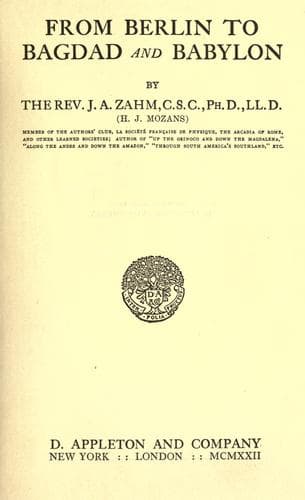
From Berlin to Bagdad and BabylonZahm, J. A. (John Augustine)
HistoryChristian
From Berlin to Bagdad and Babylon
Zahm, J. A. (John Augustine)
Middle East -- Civilization; Middle East -- Description and travel
For six centuries Constantinople had been an impregnable bulwark
against the forces of Islam. For nearly twice that space of time she
had successfully resisted the menaces and attacks of the barbarians of
the north--Goths, Huns, Avars, Russians, Bulgarians, Chazars--and had
proudly defied the power of Chosroes, Timur, Bayazid, Harun-al-Rashid,
and other leaders of savage hordes from Persia, Arabia, and Central
Asia. Unlike Old Rome, which frequently opened her gates to invaders
from the north of the Danube, New Rome never once yielded to her
Teutonic and Slavonian foes. Although besieged more than a score of
times between the fourth and the thirteenth century[54] she was able
to withstand every assault however furious or long continued. And this
she did after the vast empire which once extended from the Tigris to
the Guadilquivir had been so reduced that little was left of it but the
capital itself, which, at the time of its capture by the Turks under
Mohammed II, was scarcely more than a besieged fortress.
How the occupation of Constantinople by Mohammed the Conqueror, has
complicated the political, military, and economic conditions of Europe
for nearly five centuries is a matter of gloomy history. Owing to
its matchless position it was long the natural center of the world’s
commerce, the clearing house between Europe and Asia. Destined by
nature itself to be the seat of two worlds, Constantinople must, as
Freeman well observes, “remain the seat of imperial rule as long as
Europe and Asia, as long as land and sea keep their places.”[55]
The transfer of the capital of the Roman Empire from the
Tiber to the Golden Horn, the foundation of Constantinople in
330 A. D., was one of the master-strokes in the history of
civilization--indeed from the material and strategic point
of view, I hold it to be the greatest. Rome, Paris, London,
Vienna, Moscow, Madrid, Berlin, Washington, became capital
cities by the gradual acts of the rulers in the course of
years. But in ten years Constantinople remade the center of the
civilized world. Nothing so stupendous in civic origins has ever
been accomplished before or since, for its effects have been
maintained with rare and partial breaks for eleven, nay, for
fifteen centuries. The foundation of Alexandria by Alexander,
of Antioch by Seleucus have some parallels. Mecca, Jerusalem,
Cairo, Delhi have had fluctuating histories. Peter’s creation
of Petrograd was a splendid mistake, which has ended in hideous
failure. But the creation of Constantinople marks Constantine
as one of the truly great, beside Julius, Trajan, Charles and
Washington.[56]
But more remarkable than anything that has yet been said of the Queen
City of the Bosphorus is her marvelous continuity of imperial rule.
From the time when Constantine transferred the capital of the empire
from the Tiber to the Golden Horn, when, in the works of Dante,
_Per cedere al Pastor si fece Greco,_[57]
Public-domain text, read in full here on John Shaqi.
Reviews
Reviews
No reviews yet
Be the first to share your thoughts on this work.
Elsewhere in the archive
Join the Discussion
Join the discussion
Sign in to leave a comment or review.
Sign InorCreate an account