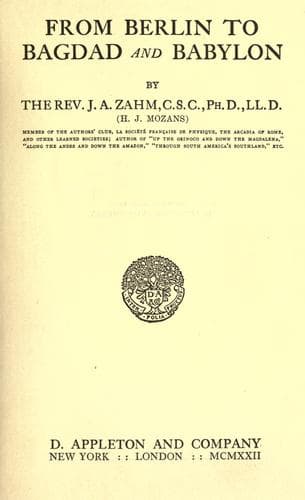
From Berlin to Bagdad and BabylonZahm, J. A. (John Augustine)
HistoryChristian
From Berlin to Bagdad and Babylon
Zahm, J. A. (John Augustine)
Middle East -- Civilization; Middle East -- Description and travel
A century and a half after the flight of Xerxes, Alexander’s army,
under Parmenio, crossed the Hellespont at the place where it had been
bridged by the ambitious and vainglorious Persian despot. It was at,
or near, this spot that Frederick Barbarossa crossed at the head of
the Third Crusade. And it was at this same spot that Solyman Pasha,
the warlike son of Orkhan, passed from Asia to Europe, where, in 1354,
he planted the Osmanli standard and where it has ever since flown as a
sign of Moslem faith and of Moslem victory over the hated Giaour.
We disembarked at the town of Chanak Kalesi, which Europeans usually
call the Dardanelles. It is noted as being at the narrowest point
of the Hellespont--the channel here is about fourteen hundred yards
in width--and was until recently the headquarters of the general in
command of the Turkish troops in the many forts which defended the
Strait.
In the long-discussed plans of Napoleon and Alexander I of Russia,
for joint dominion of the world, the Russian monarch always insisted
on securing possession not only of the Bosphorus and Constantinople
but also of the Strait of the Dardanelles. But the French emperor
just as persistently refused to acquiesce in the Czar’s demands. For
a while Napoleon seemed disposed to yield the Bosphorus and even
Constantinople, but nothing could induce him to consider for a moment
the granting to his ally of control of the Dardanelles--the key to the
Mediterranean.
Alexander insisted that, owing to its geographical position, the
Dardanelles should belong to Russia; that, having Constantinople, he
should also hold the key to the Ægean. But Napoleon retorted that, if
Russia possessed this important waterway, she would at once become
mistress not only of the commerce of the Levant and of India, but
she would also be a constant menace to Toulon, to Corfu, and to the
commerce of the world.
But the Czar and his advisers would not take a refusal. They realized
that they would never again have so good an opportunity of gaining
possession of the long-coveted capital on the Bosphorus and of the
channel connecting the Euxine with the Mediterranean as when Napoleon
was counting on their coöperation with him in his great schemes of
conquest in Asia. Negotiations continued without interruption from the
conference of Tilsit to that of Erfurt, and nothing stood in the way of
their successful issue except the possession by Russia of the narrow
strait between the Marmora and the Ægean. In return for this Alexander
was prepared to accede to Napoleon’s every wish.
Public-domain text, read in full here on John Shaqi.
Reviews
Reviews
No reviews yet
Be the first to share your thoughts on this work.
Elsewhere in the archive
Join the Discussion
Join the discussion
Sign in to leave a comment or review.
Sign InorCreate an account