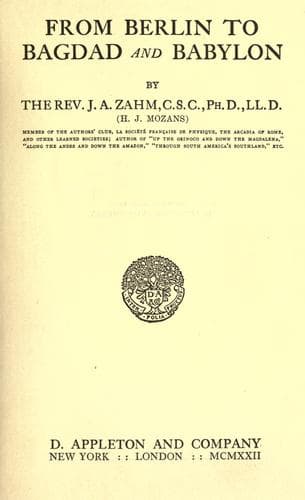
From Berlin to Bagdad and BabylonZahm, J. A. (John Augustine)
HistoryChristian
From Berlin to Bagdad and Babylon
Zahm, J. A. (John Augustine)
Middle East -- Civilization; Middle East -- Description and travel
The cradle of the Osmanlis was the small village of Sugut about a day’s
ride on horseback to the south of Nicæa and about the same distance to
the east of the Mysian Olympus. For it was here that Osman, the founder
of the Osmanli dynasty, first saw in 1258 the light of day. The first
thirty years of his life was that of a village chieftain of a pastoral
community, who lived in peace among his neighbors and whose fighting
men did not number more than four hundred. He was then fired with the
ambition to extend his boundaries and at the end of ten years he found
himself at the head of four thousand warriors and in direct contact
with the decadent and moribund Byzantine Empire.
When Osman died in 1326 his emirate of Sugut had been extended to the
Marmora and the Euxine and included in the conquered territory the
important cities of Brusa, Nicomedia, and Nicæa. This was the beginning
of one of the greatest empires the world has ever known. The same emir
of Sugut was also the founder of a dynasty whose male succession has
endured uninterruptedly for more than six centuries and the first ruler
of a people in which there is so complete a blending of Asiatic and
European blood that they have been called a distinct race.
* * * * *
No other dynasty can boast such a succession of brilliant sovereigns
as those who conducted the Ottomans to the height of renown in the
fourteenth, fifteenth, and sixteenth centuries. First there was Osman,
the originator of a race, next came his son Orkhan, the founder of
a state, and then Osman’s grandson, the creator of an empire. These
founders of an empire were succeeded by Bayazid who, on account of his
rapid movements, was called Ilderim--lightning; Mohammed, who retrieved
the losses inflicted by Timur; Murad II, the antagonist of Hunyady and
Skanderberg; Mohammed II, the conqueror of Constantinople; Selim I, who
annexed Kurdistan, Syria, and Egypt, and Solyman the Magnificent, the
victor on the field of Mohacs and the besieger of Vienna. Never did
eight such sovereigns succeed one another--save for the feeble Bayazid
II--in unbroken succession in any other country; never was an empire
founded and extended during two so splendid centuries by such a series
of great rulers. In the hour of dismay, as well as in the moment of
triumph, the Turkish Sultan was master of the situation.[93]
* * * * *
Public-domain text, read in full here on John Shaqi.
Reviews
Reviews
No reviews yet
Be the first to share your thoughts on this work.
Elsewhere in the archive
Join the Discussion
Join the discussion
Sign in to leave a comment or review.
Sign InorCreate an account