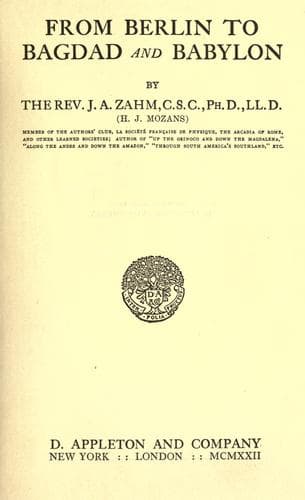
From Berlin to Bagdad and BabylonZahm, J. A. (John Augustine)
HistoryChristian
From Berlin to Bagdad and Babylon
Zahm, J. A. (John Augustine)
Middle East -- Civilization; Middle East -- Description and travel
the institution of the tribute children was the very keystone
of the Ottoman dominion. They won the empire for the Turk and
they kept it for him.... During the most brilliant days of
Ottoman greatness the native Turks were well-nigh brought down
to the condition of a subject caste. Manumitted bondmen from
the East, voluntary renegades from the West, Greek and Slavonic
tribute-children directed the councils and commanded the armies
of the Sultans. A Grand Vizier or a Captain Pasha born in the
faith of Islam was indeed noted as a portent. Never did the
craft and subtlety of devil or man devise such a tremendous
engine of tyranny. The chains of the conquered nations were
riveted by their own hands. Their best blood was drawn away to
provide against any degeneracy in the blood of their conquerors.
Their strongest and fairest children, the most vigorous frames
and the most precocious intellects, those whom nature had marked
out as chiefs and liberators of their own race, were carried
off to become the special instruments of their degradation.
This fearful institution, combined with the possession of
Constantinople, and with the marvelous hereditary greatness of
the ruling family, preserved the House of Othman from the common
fate of Oriental dynasties.
According to a long prevalent opinion, the Osmanlis are a Turkish race
who achieved the conquest of Asia Minor before they invaded Europe
and before they became masters of the Byzantine Empire. The fact is
they had subjugated the entire Balkan peninsula before they obtained
possession of more than the northwest corner of Anatolia, and had
maintained Adrianople as the Ottoman capital eighty-seven years before
Mohammed II, after the conquest of Constantinople, transferred it to
its present location on the Bosphorus.
Nor were the Osmanlis, even in their earliest days, composed entirely,
as is so often asserted, of Turkish nomads from the East. Far from it.
They were welded from the heterogeneous elements--Greeks, Carians,
Phrygians, Galatians, the followers of Osman, and other peoples who
then inhabited the north-western part of Asia Minor. And, as early
as the reign of Orkhan, the son and successor of Osman, this complex
blending of peoples became not only a distinct race but a race with a
national consciousness.
So far are the Osmanlis from regarding themselves as heirs of the
Seljukian Turks or as transformed Turkomans that they have always
endeavored to remove this erroneous impression which has so long
prevailed concerning their people. The distinguished historian,
Mouradja d’ Ohsson, declares:
Public-domain text, read in full here on John Shaqi.
Reviews
Reviews
No reviews yet
Be the first to share your thoughts on this work.
Elsewhere in the archive
Join the Discussion
Join the discussion
Sign in to leave a comment or review.
Sign InorCreate an account