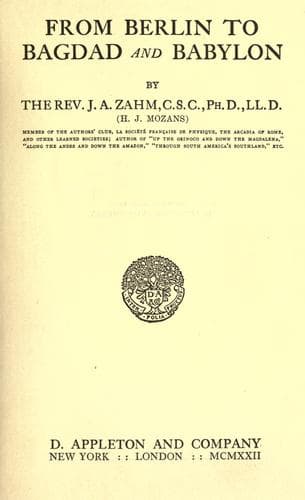
From Berlin to Bagdad and BabylonZahm, J. A. (John Augustine)
HistoryChristian
From Berlin to Bagdad and Babylon
Zahm, J. A. (John Augustine)
Middle East -- Civilization; Middle East -- Description and travel
“The very survival,” therefore, “of the Christian Churches to the
present day, is,” as the same author pertinently observes, “a strong
proof of the generally tolerant attitude of the Mohammedan governments
towards them.”[111]
Ecclesiastical writers of the epoch of the Mohammedan conquest give
still another explanation of the rapid progress of Moslem armies,
which was quite in accord with the spirit of the time. God wished,
they declared, to chastize the Christians for their infidelity and to
compel them to do penance for their manifold heresies. In their view
it was not the astounding conquests of the Mussulmans that led to the
apostasy of such vast numbers of Christians. It was rather the numerous
and widespread defections of heretical churches which rendered the
conquest of Islam so easy that it surprised the victors as much as the
vanquished. Moslem arms, then, according to these writers were but
an instrument of divine vengeance, or, as one of them expressed it,
_peccatis exigentibus victi sunt Christiani_.[112]
As one traverses the small territory which was the cradle of the
Osmanlis and reflects that the people to whom the insignificant emir
of Sugut gave his name were, from their first appearance in history,
almost within sight of the City of Constantine, one cannot help
admiring their marvelous transformation from retainers of a village
chieftain to heirs of the empire of the Cæsars, to masters of vast
territories in Asia, Africa, and Europe.[113] From the humblest
beginnings they gradually became a people who can boast of the longest
continued dynasty in Europe; and who can point in their early history
to a rare series of brilliant rulers and a line of sovereigns who have
occupied a throne which has been immovable from the days of Mohammed
the Conqueror, nearly five centuries ago, and which, notwithstanding
menaces from many quarters, seems destined to remain immovable for many
long generations to come.
CHAPTER VI
HOME LIFE OF THE OSMANLIS IN ANATOLIA
_Truths can never be confirmed enough,_
_Though doubts did ever sleep._
SHAKESPEARE _“Pericles” V. I._
No part of Asia Minor possesses greater interest for the traveler
of a studious turn than that which borders the Anatolian Railroads.
And this, as the historian well knows, is saying much indeed. For
from time immemorial the peninsula of Asia Minor has been the great
battlefield between the Orient and the Occident. Topographically it is
like a great bridge over which, as has been well said, “the religion,
art and civilization of the East found their way into Greece; and the
civilization of Greece, under the guidance of Alexander the Macedonian,
passed back again across the same bridge to conquer the East and
revolutionize Asia as far as the heart of India. Persians, Arabs,
Mongols, Turks, have all followed the same route in the many attempts
that Asia has made to subdue the West.”[114]
Public-domain text, read in full here on John Shaqi.
Reviews
Reviews
No reviews yet
Be the first to share your thoughts on this work.
Elsewhere in the archive
Join the Discussion
Join the discussion
Sign in to leave a comment or review.
Sign InorCreate an account