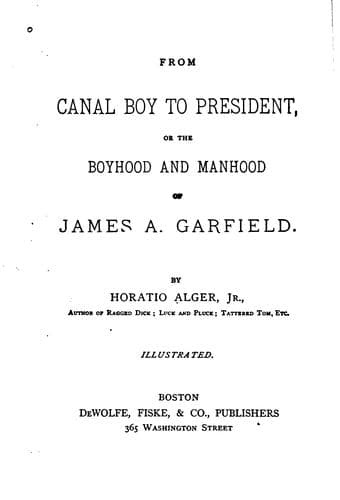
From Canal Boy to President; Or, the Boyhood and Manhood of James A. GarfieldAlger, Horatio, Jr.
History
From Canal Boy to President; Or, the Boyhood and Manhood of James A. Garfield
Alger, Horatio, Jr.
Garfield, James A. (James Abram), 1831-1881 -- Childhood and youth; Presidents -- United States -- Biography
So the new Administration entered upon what promised to be a successful
course. I can not help recording, as a singular circumstance, that the
three highest officers were ex-teachers. Of Garfield's extended services
as teacher, beginning with the charge of a district school in the
wilderness, and ending with the presidency of a college, we already
know. Reference has also been made to the early experience of the
Vice-President, Chester A. Arthur, in managing a country school. To this
it may be added that Mr. Blaine, too, early in life was a teacher in an
academy, and, as may readily be supposed, a successful one. It is seldom
in other countries that similar honors crown educational workers. It
may be mentioned, however, that Louis Philippe, afterward King of the
French, while an exile in this country, gave instruction in his native
language. It is not, however, every ruler of boys that is qualified to
become a ruler of men. Yet, in our own country, probably a majority of
our public men have served in this capacity.
CHAPTER XXXIV.
THE TRAGIC END.
I should like to end my story here, and feel that it was complete. I
should like with my countrymen to be still looking forward with interest
to the successful results of an administration, guided by the
experienced statesman whose career we have followed step by step from
its humble beginnings. But it can not be.
On the second of July, in the present year, a startling rumor was borne
on the wings of the lightning to the remotest parts of the land:
"President Garfield has been assassinated!"
The excitement was only paralleled by that which prevailed in 1865, when
Abraham Lincoln was treacherously killed by an assassin. But in this
later case the astonishment was greater, and all men asked, "What can it
mean?"
We were in a state of profound peace. No wars nor rumors of war
disturbed the humble mind, and the blow was utterly unexpected and
inexplicable.
The explanation came soon enough. It was the work of a wretched
political adventurer, who, inflated by an overweening estimate of his
own abilities and importance, had made a preposterous claim to two high
political offices--the post of Minister to Austria, and Consul to
Paris--and receiving no encouragement in either direction, had
deliberately made up his mind to "remove" the President, as he termed
it, in the foolish hope that his chances of gaining office would be
better under another administration.
Public-domain text, read in full here on John Shaqi.
Reviews
Reviews
No reviews yet
Be the first to share your thoughts on this work.
Elsewhere in the archive
Join the Discussion
Join the discussion
Sign in to leave a comment or review.
Sign InorCreate an account