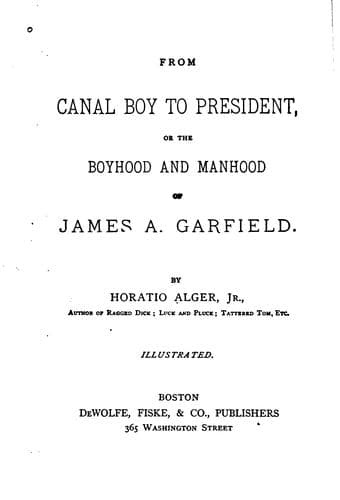
From Canal Boy to President; Or, the Boyhood and Manhood of James A. GarfieldAlger, Horatio, Jr.
History
From Canal Boy to President; Or, the Boyhood and Manhood of James A. Garfield
Alger, Horatio, Jr.
Garfield, James A. (James Abram), 1831-1881 -- Childhood and youth; Presidents -- United States -- Biography
"We are not here to question the ways of Providence. Our prayers were
not answered as we desired, though the volume and fervor of our
importunity seemed resistless; but already, behind the partially lifted
veil, we see the fruits of the sacrifice. Old wounds are healed and
fierce feuds forgotten. Vengeance and passion which have survived the
best statesmanship of twenty years are dispelled by a common sorrow.
Love follows sympathy. Over this open grave the cypress and willow are
indissolubly united, and into it are buried all sectional differences
and hatreds. The North and the South rise from bended knees to embrace
in the brotherhood of a common people and reunited country. Not this
alone, but the humanity of the civilized world has been quickened and
elevated, and the English-speaking people are nearer to-day in peace and
unity than ever before. There is no language in which petitions have not
arisen for Garfield's life, and no clime where tears have not fallen for
his death. The Queen of the proudest of nations, for the first time in
our recollections, brushes aside the formalities of diplomacy, and,
descending from the throne, speaks for her own and the hearts of all her
people, in the cable, to the afflicted wife, which says: 'Myself and my
children mourn with you.'
"It was my privilege to talk for hours with Gen. Garfield during his
famous trip to the New York conference in the late canvass, and jet it
was not conversation or discussion. He fastened upon me all the powers
of inquisitiveness and acquisitiveness, and absorbed all I had learned
in twenty years of the politics of this State. Under this restless and
resistless craving for information, he drew upon all the resources of
the libraries, gathered all the contents of the newspapers, and sought
and sounded the opinions of all around him, and in his broad, clear mind
the vast mass was so assimilated and tested that when he spoke or acted,
it was accepted as true and wise. And yet it was by the gush and warmth
of old college-chum ways, and not by the arts of the inquisitor, that
when he had gained he never lost a friend. His strength was in
ascertaining and expressing the average sense of his audience. I saw him
at the Chicago Convention, and whenever that popular assemblage seemed
drifting into hopeless confusion, his tall form commanded attention, and
his clear voice and clear utterances instantly gave the accepted
solution.
Public-domain text, read in full here on John Shaqi.
Reviews
Reviews
No reviews yet
Be the first to share your thoughts on this work.
Elsewhere in the archive
Join the Discussion
Join the discussion
Sign in to leave a comment or review.
Sign InorCreate an account