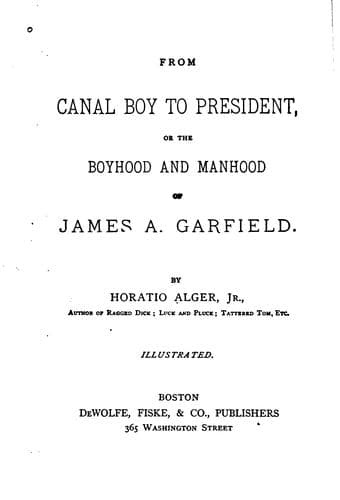
From Canal Boy to President; Or, the Boyhood and Manhood of James A. GarfieldAlger, Horatio, Jr.
History
From Canal Boy to President; Or, the Boyhood and Manhood of James A. Garfield
Alger, Horatio, Jr.
Garfield, James A. (James Abram), 1831-1881 -- Childhood and youth; Presidents -- United States -- Biography
"'For myself, the year has been full of surprises, and has brought more
sadness than joy. I am conscious of two things: first, that I have never
had, and do not think I shall take, the Presidential fever. Second, that
I am not elated with the election to that office. On the contrary, while
appreciating the honor and the opportunities which the place brings, I
feel heavily the loss of liberty which accompanies it, and especially
that it will in a great measure stop my growth.'
"March 26, 1881, in the midst of the political tempest following his
inauguration, he wrote: 'I throw you a line across the storm, to let you
know that I think, when I have a moment between breaths, of the dear old
quiet and peace of Hiram and Mentor.' How he longed for 'the dear old
quiet and peace of Hiram and Mentor' in the weary days following the
assassin's shot all readers of the newspapers know already.
"Such are some main lines in the character of this great-natured and
richly-cultured man. The outline is but poor and meager. Well do I
remember the days following the Chicago Convention, when the biographers
flocked to Mentor. How hard they found it to compress within the limits
both of their time and their pages the life, services, and character of
their great subject. One of these discouraged historians one day wearily
said: 'General, how much there is of you!'
"Space fails to speak of President Garfield's short administration.
Fortunately, it is not necessary. Nor can I give the history of the
assassination or sketch the gallant fight for life. His courage and
fortitude, faith and hope, patience and tenderness are a part of his
country's history. Dying, as well as living, he maintained his great
position with appropriate power and dignity. His waving his white hand
to the inmates of the White House, the morning he was borne sick out of
it, reminds one of dying Sidney's motioning the cup of water to the lips
of the wounded soldier. No man's life was ever prayed for by so many
people. The name of no living man has been upon so many lips. No
sick-bed was ever the subject of so much tender solicitude. That one so
strong in faculties, so rich in knowledge, so ripe in experience, so
noble in character, so needful to the nation, and so dear to his friends
should be taken in a way so foul almost taxes faith in the Divine love
and wisdom. Perhaps, however, in the noble lessons of those eighty days
from July 2d to September 19th, and in the moral unification of the
country, history will find full compensation for our great loss.
"Finally, the little white-haired mother and the constant wife must not
be passed unnoticed. How the old mother prayed and waited, and the
brave wife wrought and hoped, will live forever, both in history and in
legend. It is not impiety to say that wheresoever President Garfield's
story shall be told in the whole world there shall also this, that these
women have done, be told for a memorial of them."
Public-domain text, read in full here on John Shaqi.
Reviews
Reviews
No reviews yet
Be the first to share your thoughts on this work.
Elsewhere in the archive
Join the Discussion
Join the discussion
Sign in to leave a comment or review.
Sign InorCreate an account