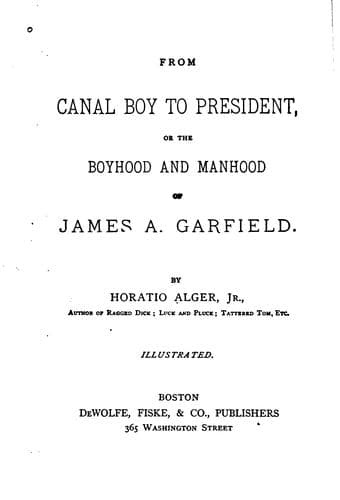
From Canal Boy to President; Or, the Boyhood and Manhood of James A. GarfieldAlger, Horatio, Jr.
History
From Canal Boy to President; Or, the Boyhood and Manhood of James A. Garfield
Alger, Horatio, Jr.
Garfield, James A. (James Abram), 1831-1881 -- Childhood and youth; Presidents -- United States -- Biography
"In the first place, there was Elihu B. Washburne, 'the watch-dog of the
treasury,' the 'father of the House,' courageous, practical, direct, and
aggressive. Then there was Thaddeus Stevens, who was one of the very few
men capable of driving his party associates--a character as unique as,
and far stronger than, John Randolph; General Robert C. Schenck, fresh
from the army, but a veteran in Congress, one of the ablest of practical
statesmen; ex-Governor Boutwell, of Massachusetts; ex-Governor Fenton,
of New York, a very influential member, especially on financial
questions; Henry Winter Davis, the brilliant orator, of Maryland;
William B. Allison, since one of the soundest and most useful of Iowa's
Senators; Henry L. Dawes, who fairly earned his promotion to the
Senate, but who accomplished so much in the House that his best friends
regret the transfer; John A. Bingham, one of the most famous speakers of
his time; James E. English, of Connecticut, who did valiant and
patriotic service as a War Democrat; George H. Pendleton, now Senator
from Ohio, and a most accomplished statesman, even in his early service
in the House; Henry G. Stebbins, who was to make a speech sustaining Mr.
Chase's financial policy that was unequaled for its salutary effect on
public opinion; Samuel J. Randall, now Speaker; John A. Griswold, of New
York; William Windom, one of the silent members, who has grown steadily
in power; James F. Wilson, who was destined to decline three successive
offers of Cabinet positions by President Grant; Daniel W. Voorhies, of
Indiana, now Senator; John A. Kasson, of Iowa, now our Minister to
Austria; Theodore M. Pomeroy, of New York, afterward Acting Speaker for
a brief period; William R. Morrison, of Illinois, since a Democratic
candidate for the Presidency; William S. Holman and George W. Julian, of
Indiana, both able men; and Fernando Wood--these were all prominent
members of the House. It will be seen that the House was a more trying
arena for a young member like Garfield than the Senate would have been;
for the contests of the former--unsubdued and unmitigated by 'the
courtesy of the Senate'--were conducted by as ready and able a corps of
debaters as ever sat in that body."
This was surely a formidable array of men, and a man of ordinary powers
would have found it prudent to remain silent during the first session,
lest he should be overwhelmed by some one of the ready speakers and
experienced legislators with whom he was associated. But the canal-boy,
who had so swiftly risen from his humble position to the post of college
president and major-general, till at the age of thirty-two he sat in the
national council the youngest member, was not daunted. His term of
service as State Senator was now of use to him, for it had given him a
knowledge of parliamentary law, and the practice in speaking which he
gained long ago in the boys' debating societies, and extended in
college, rendered him easy and master of himself.
Public-domain text, read in full here on John Shaqi.
Reviews
Reviews
No reviews yet
Be the first to share your thoughts on this work.
Elsewhere in the archive
Join the Discussion
Join the discussion
Sign in to leave a comment or review.
Sign InorCreate an account