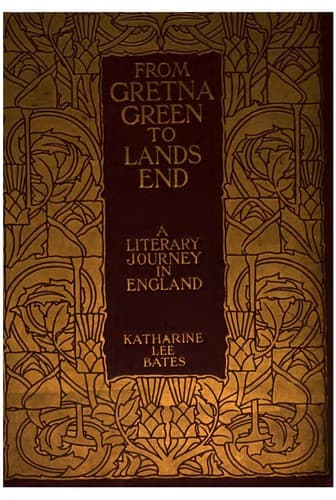
From Gretna Green to Land's End: A Literary Journey in England.Bates, Katharine Lee
General
From Gretna Green to Land's End: A Literary Journey in England.
Bates, Katharine Lee
England -- Description and travel
The magnificent old castle has seen strange sights. While undergoing
siege by Stephen, in his war against Maud, Prince Henry of Scotland,
who accompanied him, was caught up by a long iron hook and all but
pulled within the walls. Stephen himself galloped up just in time to
cut the cords with his sword and rescue the dangling prince. The
redoubtable Sir Hugh de Mortimer, Lord of Wigmore, once lay captive in
what is still known as Mortimer's Tower. It cost him three thousand
marks of silver, besides all his plate, horses, and hawks, to go free
again. Ludlow Castle was, at a later period, added by marriage to the
already formidable holdings of the Mortimers. Roger de Mortimer took
an active part in the deposition of Edward II and was created Earl of
March. In imitation of King Arthur, whose great tradition arches over
all that countryside, the ambitious young noble held a Round Table,
and conducted Queen Isabella, with whom his relations were not above
suspicion, and his boy sovereign, Edward III, to his castles of
Wigmore and Ludlow, where he entertained them with "great costs in
tilts and other pastimes." There was not room in England for him and
for a king, and his arrogant career was ended on the Smithfield
gibbet. Marlowe gives him a proud exit from the tragic stage:
"Weep not for Mortimer
That scorns the world and, as a traveler,
Goes to discover countries yet unknown."
It was his great-grandson, Edmund de Mortimer, who, by marriage with
the daughter of Prince Lionel, third son of Edward III, gave that
other Edmund Mortimer, his descendant, a better title to the throne
than that of Henry IV. This last of the Mortimers was until his death
the apparently listless centre of continual conspiracies. When he gave
up his ineffectual ghost, his estates passed to his nephew, the
vigorous Duke of York, who fixed his chief residence at Ludlow Castle.
As the York rebellion gathered force and the Wars of the Roses set
in, this neighbourhood became a centre of hostilities. The
Lancastrians, in their hour of triumph, wreaked furious vengeance on
Ludlow, but Edward IV, on his accession, consoled the town with a
liberal charter and selected it as the residence of his sons, the
Little Princes of the Tower. It is pleasant to think that before their
swift fate came upon them they had a few years of happy childhood
playing on the greensward of those spacious courts, perched up with
their lesson books in the stone window-seats, and praying their
innocent prayers within the arcaded walls of that circular Norman
chapel, built on the model of the Church of the Holy Sepulchre and
praised by Churchyard as
"So bravely wrought, so fayre and finely fram'd,
That to world's end the beauty may endure."
Public-domain text, read in full here on John Shaqi.
Reviews
Reviews
No reviews yet
Be the first to share your thoughts on this work.
Elsewhere in the archive
Join the Discussion
Join the discussion
Sign in to leave a comment or review.
Sign InorCreate an account