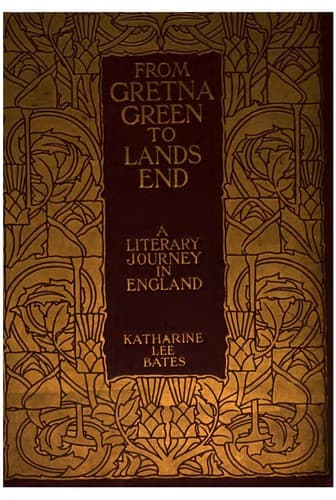
From Gretna Green to Land's End: A Literary Journey in England.Bates, Katharine Lee
General
From Gretna Green to Land's End: A Literary Journey in England.
Bates, Katharine Lee
England -- Description and travel
The last Lord Marcher before the Restoration was the Earl of
Bridgwater, whose appointment was most gloriously celebrated by the
creation of Milton's "Comus," presented on Michaelmas Night, 1634, in
the Great Hall of the castle. The first to hold the office--thenceforth
only nominal--after the Restoration was the Earl of Carberry, whose
seneschal was one Samuel Butler, a steward who may or may not have kept
good accounts, but who used his pen to effective purpose in writing, in
a chamber over the gate, the first portion of "Hudibras."
Ludlow is the centre for fascinating excursions. The delicious air and
most lovely scenery tempt one forth on roads that run between
bird-haunted banks fringed with luxuriant bracken and lined with all
manner of trees to whose very tops climbs the aspiring honeysuckle.
The glint of red berries from the mountain ash, the drooping sprays of
the larches, the silvery glimpses of far vistas framed in leafy green,
the spicy forest fragrances, the freshness and buoyancy of the air,
all unite to make the spirit glad. From every rise in the road are
views that range over a fair outspread of plain and valley, rimmed by
gentle hills. All over Worcestershire we looked, and into Wales, and
up through Salop to where the Wrekin smiled a gracious recognition.
Points of special interest abound,--Haye Wood, where Lady Alice,
daughter of the Earl of Bridgwater, and her brothers lost their way
and by their little adventure gave young Milton the suggestion for his
Masque; St. Mary's Knoll, once crowned by a venerated image of the
Virgin; Oakley Park, with its Druid trees; the little church of Pipe
Aston, with its curious semi-cirque of Norman carving over the door;
Leinthall church, overtopped at either end by lofty yews; British
fort; Tudor mansion; storied battlefield.
Our first goal was Richard's Castle in Hereford, dating from the reign
of Edward the Confessor,--a Norman keep before the Norman Conquest.
Nothing of that brave erection is left save a mound of earth and a bit
of broken wall. Near by stands an old church with some remnants of
fine glass and with the rare feature, in England, of a detached
bell-tower. We lingered in the church yard, looking out from a massive
recumbent slab that was cleft from end to end, as if the impatient
sleeper could not wait for the Archangel's trump, eastward to the
Malvern Hills, whose earthly blue melted as softly into the blue of
the sky as life melts into death. But a line of rooks flapping
roostward awoke us to the flight of time, and the pensive appeal of
that quiet spot, with its lichened crosses and grave-mantling growths
of grass and ivy, was dispelled by a donkey who thrust his head
through a green casement in the hedge and waggled his long ears at us
with a quizzical expression.
Public-domain text, read in full here on John Shaqi.
Reviews
Reviews
No reviews yet
Be the first to share your thoughts on this work.
Elsewhere in the archive
Join the Discussion
Join the discussion
Sign in to leave a comment or review.
Sign InorCreate an account