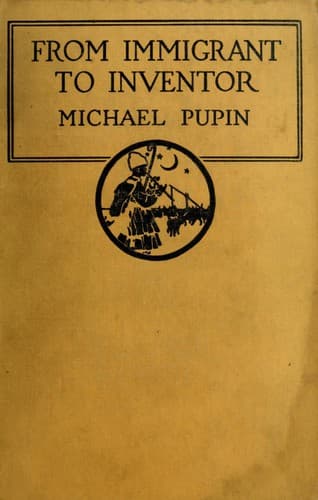
Inventors -- United States -- Biography; Pupin, Michael, 1858-1935
in Cortlandt Street nine years before, my hard luck of having had no
earlier training. Many an American college student of physics bemoaned
in those days his lack of early laboratory training. When I say this
I am touching the principal point of my narrative; it is the point at
which my narrative begins to sail on the back of a wave which started
actually when Johns Hopkins University was organized, in 1876, but the
motive power of which had been gathering long before that, perhaps at
the same time when the motive power of the Cambridge movement in favor
of scientific research was gathering, resulting, as it had, in the
establishment of the Cavendish Laboratory. But I must resume the thread
of my story and return later to the point just mentioned.
My lack of what Barnard called “knowledge of visible things ...
acquired by the learner’s own conscious efforts ...” gave me much
anxiety; and I often thought that it would, perhaps, be better to go
to some other university where the director of the physical laboratory
was an older man, who would not notice my age as much as would the new
and extremely young director of the Cavendish Laboratory. That thought,
however, did not console me much, because I was very much attached
to Cambridge and did not wish to give up what my mother called “life
among the saints of Cambridge.” Just then, as if by an act of kind
providence, a letter from President Barnard of Columbia College reached
me, enclosing a letter of introduction to John Tyndall, the famous
physicist, colleague and successor of Faraday in the direction of the
Royal Institution. Barnard informed me that Columbia had received a
generous sum of money from Tyndall, representing a part of the net
proceeds from his famous course of public lectures on light, which
he had delivered in the United States in 1872-1873; that the income
of this sum would be given as a fellowship to a Columbia graduate to
assist him in his study of experimental physics; that the fellowship
would be called a John Tyndall Fellowship, netting over five hundred
dollars annually; and that he and Rood, professor of physics at
Columbia, considered me a suitable candidate. Unexpected things of
this kind happen every now and then, and when they do they certainly
encourage the belief that there is such a thing as luck.
Public-domain text, read in full here on John Shaqi.
Reviews
Reviews
No reviews yet
Be the first to share your thoughts on this work.
Elsewhere in the archive
Join the Discussion
Join the discussion
Sign in to leave a comment or review.
Sign InorCreate an account