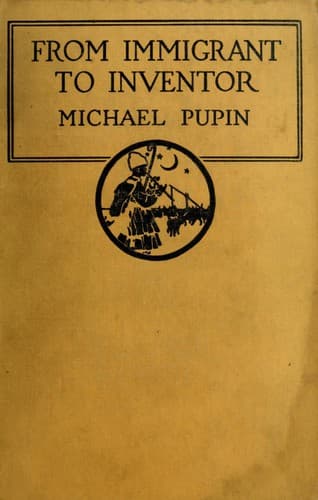
Inventors -- United States -- Biography; Pupin, Michael, 1858-1935
The summer vacation was on and I decided to take Faraday’s “Electrical
Researches” to Scotland, the land of Maxwell. In the preface to his
great--and to me, at that time, enigmatic--electrical treatise Maxwell
modestly had stated that he was an interpreter, only, of Faraday. But
I was delighted when I heard Tyndall’s suggestion that Faraday would
help me to interpret Maxwell. Perhaps, thought I, the invigorating air
of Maxwell’s native Scotland would help me to catch some of the ideas
which Maxwell had caught when he was reading Faraday. I selected what
I thought would be a quiet and secluded spot, the island of Arran.
It belonged to the Duke of Hamilton, and I was told that his grace
had imposed so many restrictions upon his tenants that the island
had become an ideal spot for those who sought seclusion. I found
there a neat little inn at Corrie. It was surrounded by several tiny
cottages for summer visitors who took their meals at the inn. It was
popular with people from Glasgow, Greenock, and Paisley. Every one
of the visiting families was blessed with numerous daughters. They
were very athletic and played tennis from early morning till late in
the afternoon, interrupted now and then by swimming contests in the
frigid waters of the Firth of Clyde. In the evening there was lively
dancing--not easy-going waltzing, but the real fling and reel of the
strenuous Highland type. “What a sturdy race this is,” I said to
myself, as I watched the dancers working themselves up into a frenzy
of rhythmic movements, one hand resting upon the hip, the other raised
high up in the air, while their joyful limbs were pumping up and down
in perfect rhythm as if they were busy pulling up from mother earth all
the earthly joys stored up there for mortal man. The whole scene was
particularly thrilling to me when a piper came along and furnished the
music. The bagpipes reminded me of my native Idvor, and made me feel at
home in bonny Scotland before I had been much over a week in Arran. The
Scotch and the Serbs have many things in common, and I always believed
that somewhere back in the history of Iran they must have belonged to
the same tribe. I am told that at the Macedonian front the Scotch and
the Serbian soldiers got along beautifully, as if they had known each
other from time immemorial, and they had little use for the other races
assembled there. I got along at Corrie as if I had known the Scotch all
my life. But that had its disadvantages also. I came to Corrie looking
for seclusion where, undisturbed, I could communicate with Faraday.
But the lively lassies from Glasgow, Greenock, and Paisley, the tennis
and the swimming contests, the fascinating sound of the bagpipes
accompanying the stirring Highland dances--all these things whispered
into my ear: “Faraday can wait, but your friends here cannot.” Then I
remembered a passage in one of Maxwell’s letters, given in Campbell’s
life of Maxwell, which said: “Well, work is good and reading is good,
Public-domain text, read in full here on John Shaqi.
Reviews
Reviews
No reviews yet
Be the first to share your thoughts on this work.
Elsewhere in the archive
Join the Discussion
Join the discussion
Sign in to leave a comment or review.
Sign InorCreate an account