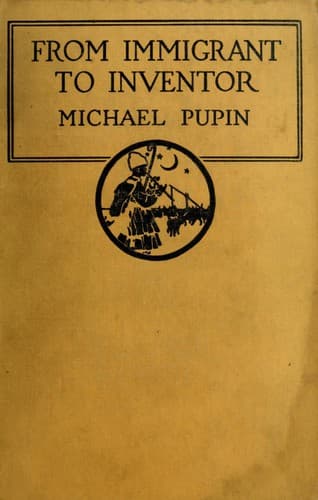
Inventors -- United States -- Biography; Pupin, Michael, 1858-1935
Archimedes, Galileo, and Newton co-operated in the
discovery of immutable laws, and thereby revealed to mortal man morsels
of the _eternal truth_. Oerstedt, a hundred years ago, discovered a
morsel of the eternal truth when he discovered the magnetic force which
is produced by the motion of electricity. Discoveries of immortal
things and of the immutable laws which direct the mission of their
immortal existence are themselves immortal. Their discoverers are, and
deserve to be, immortal. Tyndall and Maxwell were the first to show me
that Faraday occupied a distinguished place among such immortals as
Archimedes, Galileo, Newton, and Oerstedt.
The closing sentence of Maxwell’s biographical sketch of Faraday, in
vol. VIII of _Nature_, referred to above, reads as follows:
We are probably ignorant even of the name of the science which will
develop out of the materials we are now collecting, when the great
philosopher next after Faraday makes his appearance.
To me these prophetic words indicated that Maxwell had something in
his mind which was not explicitly expressed in Faraday’s discoveries,
but which enabled Maxwell to speak like a prophet. The words of a
prophet are not always easy to understand. I discovered later that,
when the world with the aid of the Hertzian experiments had caught
Maxwell’s meaning, then a new and wonderful epoch in the history of
the physical sciences was inaugurated. Its end is not yet in sight.
This inauguration I witnessed during my student days in Berlin. It is,
I believe, of considerable interest to record here how the scientific
world, as I saw it at that time, appeared to be preparing to receive
the great revelation which was delivered to it on that historic
inauguration day in 1887.
My communion with Faraday on the island of Arran began my own
preparation for this inauguration day by developing gradually in my
mind new physical concepts, which I discovered later to be fundamental
physical concepts in the modern views of physics. Long before I
had finished my reading of Faraday’s “Experimental Researches in
Electricity,” I began to understand why Tyndall, referring to them,
said: “Read them; their story is just as new and as stirring to-day as
it was when these volumes were first printed. They will help you much
to interpret Maxwell.” The same statement is true to-day, and therefore
I proceed now, with much trepidation, to tell a part at least of that
story as briefly as I can, in order to describe, even if it be quite
inadequately, Faraday’s relation to the present great epoch of modern
physics, the epoch of the electromagnetic view not only of _light_ but
also of _matter_.
Public-domain text, read in full here on John Shaqi.
Reviews
Reviews
No reviews yet
Be the first to share your thoughts on this work.
Elsewhere in the archive
Join the Discussion
Join the discussion
Sign in to leave a comment or review.
Sign InorCreate an account