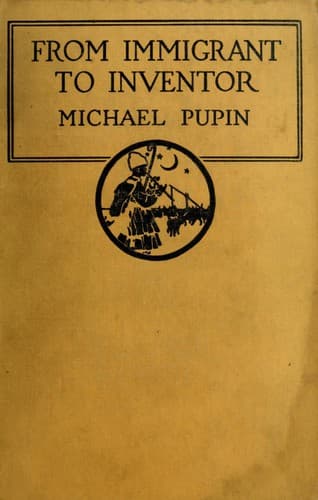
Inventors -- United States -- Biography; Pupin, Michael, 1858-1935
During my first year’s study in Berlin I attended Helmholtz’s lectures
on experimental physics. They were most inspiring, not so much on
account of the many beautiful experiments which were shown, as on
account of the wonderfully suggestive remarks which Helmholtz would
drop every now and then under the inspiration of the moment. Helmholtz
threw the search-light of his giant intellect upon the meaning of
the experiments, and they blazed up like the brilliant colors of a
flower garden when a beam of sunlight breaks through the clouds, and
tears up the dark shadows which cover the landscape on a cloudy summer
day. These lectures were attended not only by students in physics,
mathematics, and chemistry, but also by medical students and army
officers. The official world, and particularly the army and navy, paid
close attention to what Excellenz von Helmholtz had to say; and I had
much reason to believe that they consulted his scientific opinions
at every step. I have often been called upon to correct the opinion
that Helmholtz was a pure scientist par excellence. There is no doubt
that his great work dealt principally with fundamental problems in
scientific theory and in philosophy; but there is also no doubt that,
like many other German scientists, he was much interested in the
application of science to the solution of problems which would advance
the industries of Germany. His earliest career is associated with his
invention of the ophthalmoscope. The optical glass industry of Germany
was being developed by some of his former students, who led the world
in geometrical optics, a part of physics to which Helmholtz devoted
much attention in his younger days.
One day I was on my way to the institute; in front of me walked a tall
German army officer, smoking a big cigar. When we reached the entrance
of the institute the officer stopped and read a sign which said:
“Smoking is strictly forbidden in the institute building.” He threw
his cigar away and walked in. I recognized Crown Prince Frederick in
the officer. Two years later he became Emperor of Germany and ruled
for ninety days. I watched his footsteps and saw that he entered
Helmholtz’s office and stayed there over an hour. He undoubtedly
consulted the great scientist on some scientific problem which was then
interesting the German army and navy.
Helmholtz’s personality was overpowering and seemed to compel one’s
interest in problems in which he was interested, and at that time
his principal interest was outside of the electromagnetic theory.
Nevertheless, I kept up my interest in Faraday, which interest I
brought with me from Arran; but I found no opportunity to ascertain
Helmholtz’s opinion concerning Faraday. Finally the opportunity came
toward the end of my first year at the University of Berlin.
Public-domain text, read in full here on John Shaqi.
Reviews
Reviews
No reviews yet
Be the first to share your thoughts on this work.
Elsewhere in the archive
Join the Discussion
Join the discussion
Sign in to leave a comment or review.
Sign InorCreate an account