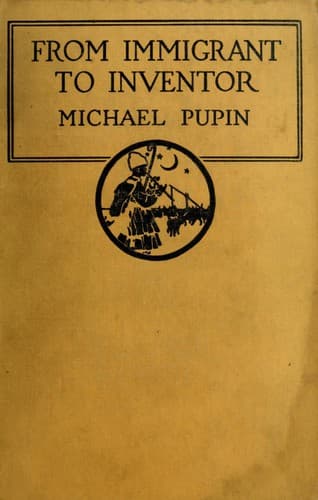
Inventors -- United States -- Biography; Pupin, Michael, 1858-1935
No sooner had Perrin, a French physicist, demonstrated that the cathode
rays were negative electricity moving from the negative electrode of
a vacuum-tube to the positive electrode than Professor John Joseph
Thomson, of the University of Cambridge, proved that this negative
electricity is concentrated in small corpuscles, called electrons
to-day, which move with great velocities, and that the ratio of the
electrical charge to the mass of each electron is experimentally
determinable, and is, under ordinary conditions, a definite and
invariable quantity. This learned man, when a youth of only
twenty-five, had predicted in 1881, fourteen years before Roentgen’s
discovery, that the cathode rays were small negatively charged bodies,
moving with great velocities. Assuming them to be spherical, he
calculated, by the Faraday-Maxwell electromagnetic theory, the ratio
of their charge to their mass. He showed theoretically that their mass
consisted of two parts, one of which is the ordinary gravitational or
material mass, and the other a new mass which is proportional to the
electrical energy in the electron, and that this mass also depended
upon the velocity of the motion in a definite way. He devised and
employed an experimental method to determine this ratio. The most
remarkable feature of this interrelation between the electromagnetic
mass and the velocity of motion was the fact that when the velocity
approached the velocity of light the mass approached an infinitely
large value. But no such extremes of velocity of motion of the
electrons in a vacuum-tube were found at that time.
Public-domain text, read in full here on John Shaqi.
Reviews
Reviews
No reviews yet
Be the first to share your thoughts on this work.
Elsewhere in the archive
Join the Discussion
Join the discussion
Sign in to leave a comment or review.
Sign InorCreate an account