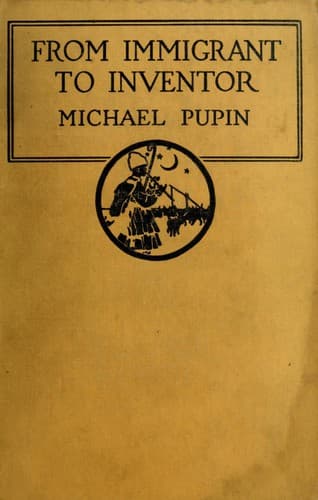
Inventors -- United States -- Biography; Pupin, Michael, 1858-1935
Has science changed that vision of the early childhood days? What does
that light convey to my mind to-day? The answer to this question was
born during my lifetime, and the gradual unfolding of its profound
meaning gave me the sweetest thrills of my life. Faraday and Maxwell
told me that light is a manifestation of the activity of electrical
force. The discovery of the Roentgen rays and of radioactivity taught
me that the primordial sources of electrical force are the positive and
the negative electrons, the electrons and the protons, the building
stones of matter, and that light is radiation, that is, propagation
into space of the electrical energy from the atomic structures in
which the electrons with their motions determine the character of the
structure and its energy content. Then came Thomson, the same Thomson
who scared me away from Cambridge, because I thought that he was too
young to be my teacher of physics, and he suggested that the electrons
possess an inertial mass on account of the electrical energy which
is stored up in them. This suggestion led to the generalization that
all electrical energy has mass possessing not only inertia but also
gravitational action. Who does not know to-day of this generalization,
and who has not heard of Einstein and of his verified prophecy that a
beam of light will be deflected by gravitational force? A beam of light
represents electrical energy and electrical energy is gravitationally
active just like any other mass considered by Newton. A star radiating
light radiates electrical energy, and, therefore, it throws out to us
a part of its own mass. When this radiation reaches us we can say,
therefore, without indulging in figures of speech that the star is
visiting us. I am not indulging in a flowery figure of speech when I
call solar radiation the balmy breath of the heavenly bridegroom, the
glorious sun.
Public-domain text, read in full here on John Shaqi.
Reviews
Reviews
No reviews yet
Be the first to share your thoughts on this work.
Elsewhere in the archive
Join the Discussion
Join the discussion
Sign in to leave a comment or review.
Sign InorCreate an account