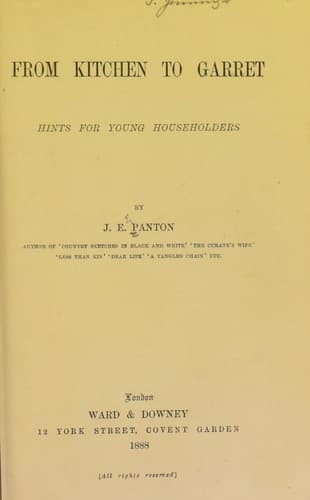
From Kitchen to Garret: Hints for young householdersPanton, J. E. (Jane Ellen)
General
From Kitchen to Garret: Hints for young householders
Panton, J. E. (Jane Ellen)
Home economics
And, while we are on the subject of servants’ rooms, I will just make a
few remarks on this most intricate subject of domestic management, and
will whisper what I really think is at the bottom of a good many of the
troubles anent servants that undoubtedly exist. In the first place,
mistresses are all too often like the parents of grown-up sons and
daughters, who cannot remember that the curled and frilled darlings of
the nurseries have become young men and women, and are exchanging the
control of the schoolroom for the kindly advice that should never be out
of place between parent and children, who, grow as tall as they will,
can _never_ be as old as those to whom they owe their existence. And
inasmuch as parents all too often exercise this control when advice
would be so much more in place, so do mistresses control and fret the
maids, who would not fret at all were the silk chain, ‘Don’t you think?’
used instead of the arbitrary command, ‘I insist on the work being done
as I order it.’ Then, too, we are all apt to forget how dull the
ordinary routine of a servant’s life is. True, she has the joy of her
morning gossip with the tradesman, and her few hours on Sunday; but that
is not much for a young healthy girl, who appreciates pleasure as well
as do our tennis-playing, ball-going daughters, and it is much better to
try and give her some amusement oneself, instead of winking at the
‘evenings out’ and furtively stolen absences which most mistresses
allow, because, otherwise, their maids would not stay. This can easily
be done in these days by any one who lives in or near town; while even
in the country there are always excursions to be made, or the county
town to be visited, even if there are no picture-galleries or
exhibitions as there are in London.
Besides which, servants like to know what is going on, even if they
cannot go to things themselves. They fully appreciate being told of what
one has seen oneself, and a cheerful account of a visit to London or to
the theatre, &c., is as much appreciated by a maid as by the friends we
regale with our experiences, who no doubt do not care for the account at
all, and only wonder at our foolishness in wasting our time and money.
We have to face a great fact, also: in olden days our mothers as well as
their maids were content with very much less than we are. They may have
been, and no doubt were, much happier, but that is beside the question,
more especially as we cannot return to the ‘good old days’ even if we
would; but the fact remains the same. We have advanced, so have our
servants; and when they can beat us at sums and geography, stand too
much on our level to be thought of merely as the servants, who are to be
content with anything we may choose to give them, and therefore must be
treated in an entirely different manner to the old style.
Public-domain text, read in full here on John Shaqi.
Reviews
Reviews
No reviews yet
Be the first to share your thoughts on this work.
Elsewhere in the archive
Join the Discussion
Join the discussion
Sign in to leave a comment or review.
Sign InorCreate an account