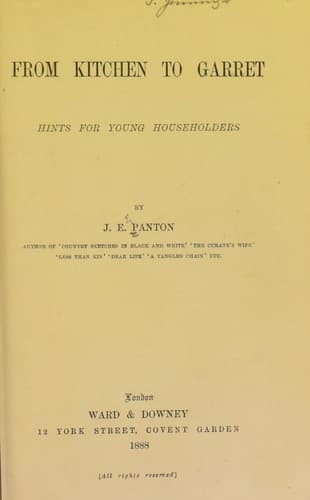
From Kitchen to Garret: Hints for young householdersPanton, J. E. (Jane Ellen)
General
From Kitchen to Garret: Hints for young householders
Panton, J. E. (Jane Ellen)
Home economics
There is just one other point to touch upon, that of the meals of the
kitchen. It is quite enough to allow an ordinary middle-class household
good bread and butter, oatmeal porridge, and tea, coffee, or cocoa for
breakfast; the kitchen dinner should be the same as the dining-room
luncheon; tea might be supplemented by jam or an occasional home-made
cake; and supper should be presumably bread and cheese, but any soup
made from the receipts in the chapter on ‘entertaining,’ or odds and
ends left at the late dinner, can be consumed if you can trust your
cook; if you cannot, you must lay down a hard-and-fast rule of bread and
cheese, and insist on its being kept, otherwise you will find yourselves
in the case of a friend of mine, who went into her larder after an
enormous dinner-party, expecting to find herself free from the necessity
of ordering more food for at least a week, and discovered it empty,
swept, and garnished, because, the cook informed her, they always had
for their suppers any little thing ‘as was’ left over.
Never be afraid to praise your servants, as one lady is I know of, for
fear they may think she cannot do without them: we _can’t_ do without
them--why should we pretend we can? They are far more likely to remain
where they are appreciated and cared for than where they know they are
only looked upon as so much necessary furniture; and do not be afraid to
blame them, emulating another friend of mine, who saw her servant
reading her letters at her desk, and stepped out of the room unobserved
because she shrank from the disagreeable but emphatically necessary task
of telling the maid of her odious and dishonourable fault; but say
straight out to the delinquent servant herself what you have in your
mind against her, never sending the message by another servant, nor
nagging, but remarking firmly what you have to say yourself in such a
way that she cannot avoid perceiving you mean emphatically what you
say.
Let your maids have good books to read, and let them see newspapers, but
do not keep a kitchen bookshelf. This they distrust at once, and look
out for their own literature, which is generally pernicious; but if you
yourself have read a good story, recommend it to them, and talk to them
about it. You can always get a servant to read proper books by taking
care to read them yourself, and by letting them see you are sharing your
literature with them; even if they spoil or soil the book, books are
cheap, and they had better do this than soil their minds by the rubbish
they might buy, revolting naturally against ‘Lizzy, or a Parlourmaid’s
Duties, described in a story,’ or ‘Grace, or How to Clean Silver,’ or
the similar charming works which one generally finds in the houses of
those who keep ‘kitchen bookshelves,’ regardless of the fact that Ouida
and other exquisite feminine novelists are the favourite food of the
drawing-room, and that they could not read one page of the ‘books’
themselves provided for the maid’s entertainment.
Public-domain text, read in full here on John Shaqi.
Reviews
Reviews
No reviews yet
Be the first to share your thoughts on this work.
Elsewhere in the archive
Join the Discussion
Join the discussion
Sign in to leave a comment or review.
Sign InorCreate an account