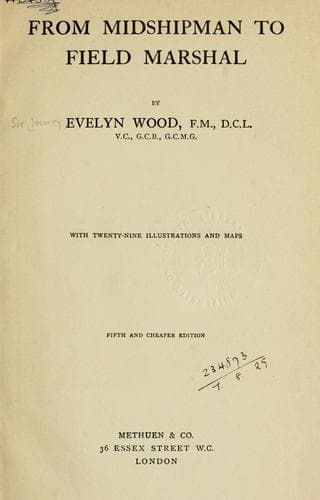
Great Britain -- History, Military -- 19th century; Marshals -- Great Britain -- Biography; Wood, Evelyn, 1838-1919
The difficulties of the march had not been exaggerated by the old
hands at Kirki, when they predicted our return. It generally rained,
but on other days we were scorched by the burning sun, and on one
occasion the recorded heat in a Medical officer’s double-roofed tent
was 115° Fahrenheit. When therefore it seemed that Sir Hugh Rose (who
was advancing from Sehore to relieve Ságar, the then last remaining
besieged garrison) had stamped out the rebellion in Central India,
orders were received for the Squadron to remain at Jalna till after
the Monsoon. While furniture was being put into bungalows for our
accommodation, the news of the outbreak at Gwáliár was received, and
with it an order for the Squadron to march rapidly to Máu.
That Station, which had been sacked by Mutineers in 1857, standing on
an elevated plateau, is comparatively cool even in the summer season,
but the day before we ascended the Ghaut and the night we camped at
its foot were really hot; metal cups, after lying in the sun, burnt
the hand on being touched, the backs came off our hair-brushes, and
hair-combs assumed serpentine forms. Between Poona and Máu, where we
arrived on the 20th July, we forded thirty-five rivers and streams, and
swam our horses across two large rivers. The Narbadá was the easiest
of the rivers to cross, because boats and trained boatmen were ready,
as were Native swimmers for the horses. The men of the Haidarábád
Contingent thought it beneath their dignity to work, and after crossing
one of the rivers wished to wait until coolies were collected to carry
their saddles and equipment from the edge of the water to the top of
the bank; when, however, they saw me pull off my coat and carry my own
saddle, they followed my example.
When I arrived at Máu I was sent for by, and made the acquaintance of
Major-General Michel[57] under the following circumstances:--After
we left Asseerghur, making a comparatively short march, we arrived
early at a village, and found everything we required except forage.
The chief man of the village declared that he had sent for grass, and
vowed that there was no dry forage in the neighbourhood; but something
in his manner induced me to doubt the accuracy of his statement. At
four o’clock, on again sending for him, he made men pull the thatch off
some of the poorest houses in the village to give it to the horses.
Meanwhile I took two Lancers with me, and found in the enclosure
of his own house enough forage for a Cavalry regiment, and marched
him, a Brahman, to Sir William Gordon, who ordered me to have him
flogged. This was the cause of my being sent for by the General, for
the Political authorities had expended much energy in trying to trace
the names of the officers who had so acted. Gordon wanted to take all
responsibility, but I told the General that having been ordered to
reach Máu as soon as possible, the horses required something beyond
dana (grain), and it was my action which induced the punishment.
Public-domain text, read in full here on John Shaqi.
Reviews
Reviews
No reviews yet
Be the first to share your thoughts on this work.
Elsewhere in the archive
Join the Discussion
Join the discussion
Sign in to leave a comment or review.
Sign InorCreate an account