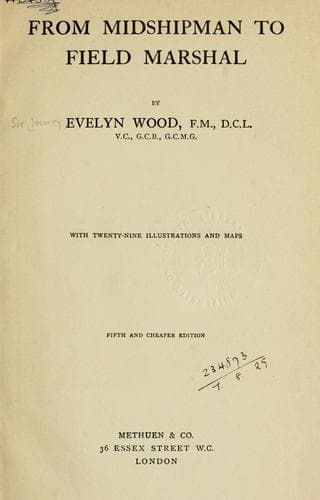
Great Britain -- History, Military -- 19th century; Marshals -- Great Britain -- Biography; Wood, Evelyn, 1838-1919
About eleven o’clock I was riding in a shallow valley in front of my
party of twenty men, and probably the hot sun had made me drowsy,
for although a few minutes previously I had seen a large hyena which
crossed our path, I was startled by hearing the clang of horses’ hoofs,
and looking round, saw my escort retreating. I thought they might be
flying from a tiger, but looking up saw 300 yards ahead two men in red
coats, who as I afterwards learned belonged to Umjid Ali’s[61] party
of the Gwáliár Contingent. While I was looking at the two warriors
in front, I noticed that they had their backs turned to me, and they
seemed undisturbed by our approach, so I continued to ride towards
them, and was rejoined by my escort. Our Staff arrangements in the
column were not good, for although the Officer had sent out these
men, he had not thought it necessary to inform me they were on the
same business, which might easily have given rise to accidents, as
they wore identically the same uniform as their former comrades the
rebels. Nothing occurred during the day to indicate the enemy would
move farther south. They were probably distributing the spoils of Jalra
Patan. Meanwhile a column of Europeans, with Gordon’s Squadron of the
17th Lancers, was hurrying up to reinforce us, which they did three
days later, but the European Infantry marched with great difficulty in
the oppressive heat.
We moved on the 10th September towards Tantia, who had 30 guns and many
warriors obtained in Jalra Patan, and for three days marched in order
of battle. The Infantry felt the intense heat, though they were spared
unnecessary fatigue by the Native Cavalry, which passed through all
high-standing grain crops and swamps. In fording the Kala Sind River we
lost a good deal of baggage, many mules being washed away. On the 12th
the rain came down so heavily that it was impossible to move our camp,
nor did our enemy attempt to march. On the 14th the Advance Guard, a
Squadron of the 17th, 98 all Ranks, Native Cavalry 190 sabres, and 3
guns, arrived at Rajghur. As we halted in sight of the enemy’s camp
they began to strike tents. The European Infantry were much exhausted
by the previous march, on which several men had died from sunstroke.
We waited impatiently for them to come up, as a strong Cavalry picket
crossing the river halted for two hours within half a mile of us. Then
the General rode up, and said the Infantry could not advance, and must
encamp where they were.
Two battalions of Native Infantry now came up, and volunteered to
attack; but the General naturally wished to wait till the Europeans
could take part in the action. He left me with one Squadron of Native
Cavalry, with orders to hold my ground at all costs till the Europeans
had rested.
Public-domain text, read in full here on John Shaqi.
Reviews
Reviews
No reviews yet
Be the first to share your thoughts on this work.
Elsewhere in the archive
Join the Discussion
Join the discussion
Sign in to leave a comment or review.
Sign InorCreate an account