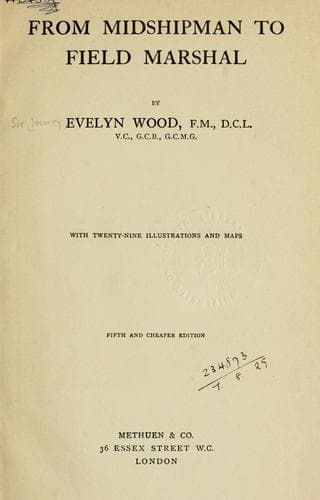
Great Britain -- History, Military -- 19th century; Marshals -- Great Britain -- Biography; Wood, Evelyn, 1838-1919
We marched on the 21st to Lalitpúr, and having encamped, nearly all of
us were asleep in the afternoon, when fifty rebel horsemen came into
the village in ignorance of our presence. Sir William Gordon mounted,
but did not overtake the fighting men, bringing in only some of the
camp followers. Tantia doubled back between us and the Betwa River,
passing within four miles of our camp; we followed, and our European
Infantry, consisting of a wing of the 71st and 92nd Highlanders, for
the next three days covered long distances. We generally started in
the middle of the night; our first march, on the 23rd October, was
27 miles; next day, 29 miles; and on the 25th October, 17 miles. The
General had promised the Infantry a halt, but as we came on the spot
selected for our camping-ground near Kurai, the rebels arrived there at
the same moment.
I quickly shifted the saddle on to “The Pig,” and accompanied the
Native Cavalry out to the flank, while our Infantry advanced in an
extended line. Organised resistance soon ceased, and during the
pursuit the mounted troops spread out on an extended frontage, the
Cavalry separating into three bodies. I had led a Squadron against a
collected body of the Rebels, and then, to avoid seeing them killed,
I followed, with a dozen soldiers, a formed group of men; leaving my
followers engaged in exterminating them, I rode at a Sepoy who escaped
into a jowarry field. I pursued him, but when I got into the middle
of the field regretted having done so, for the stalks were stiff and
strong, and I had to spur my horse sharply to induce him to move. If
the Sepoy had realised my difficulty, and awaited my coming, I must
have fought at a disadvantage; he went through the grain however, and
halted on a clear spot. As I approached he threw down his musket, which
was empty, and drawing a sword, cried, “Sahib, I know I must die, but
it is not an officer’s duty to kill individuals; send a private to
fight me. I shall either wound or kill you.” I replied, “It is more
likely I shall kill you,” as I cantered at him. He was an active man,
and threw himself down on his back so suddenly as to escape the point
of my sword, irritating me by cutting at my horse’s hocks. Now I had
given £110 for the horse, and having no money to replace it, I lost my
temper, calling to the Sepoy that I had taken him for a warrior, and
not a horse-slaughterer. Before I could turn the horse, my men, who had
come up, by getting round the Rebel in a circle effectually prevented
my fighting him by approaching at speed, as all Cavalry soldiers should
do. He kept five or six at bay for some minutes by snicking their
horses’ faces, until he fell to a pistol shot.
We killed in the pursuit about 150 of the rebels, and the General
estimated their total losses at 350. Tantia fled towards Ratghur, and
then turning south-west moved by Garaispur towards Bhopál, where,
forestalled by another small column, he crossed the Narbadá.
Public-domain text, read in full here on John Shaqi.
Reviews
Reviews
No reviews yet
Be the first to share your thoughts on this work.
Elsewhere in the archive
Join the Discussion
Join the discussion
Sign in to leave a comment or review.
Sign InorCreate an account