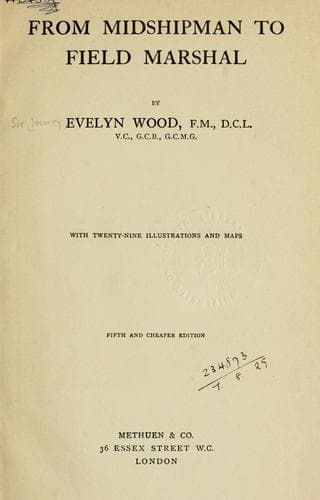
Great Britain -- History, Military -- 19th century; Marshals -- Great Britain -- Biography; Wood, Evelyn, 1838-1919
The General ordered me--for though put as an invitation it was
practically an order--to come and live with him, stating he lived “Camp
fashion,”[76] and our fare would be plain. Plain it was, but this did
not disturb me so much as the want of refinement. He had lived in great
discomfort, with iron cups and metal plates, which were seldom washed.
I nevertheless soon got to like my Chief, admiring his boundless
energy, and my butler improved the serving of our meals.
I rode down to Poona from Árangábád in September. The Colonel followed
me about a week later on his way to Europe, and I spent the next two
months at Poona and Bombay preparing for my examination. I overtaxed
my strength in endeavouring to read seven hours daily with Moonshees,
and five to seven hours by myself. A Doctor insisted on my doing less,
but I was young and foolish, and as a result, on the 3rd October, when
at Bombay, I awoke with severe pain in my ears, which continued for a
week, leaving me so deaf that I had difficulty in hearing the Examiner
dictating Hindustani.
I was better on the 15th, when the colloquial examination was held, and
therein I reaped the advantage of the continuous practice I had had in
the twelve months since leaving Kirki. I was naturally fluent, and as I
took up for the examination 2000 words, had an unusual vocabulary at my
command, and passed the examination for Interpreter without difficulty,
at a cost of from £180 to £200. I rode back to my Station with renewed
health, the deafness passing away when I ceased to overtax my strength.
I remained at Árangábád three days, employed in packing the Brigade
office papers, and then started to join the Officer commanding the
1st Regiment, who was now in command of the Brigade. From Árangábád
to Bersia, where I arrived on the 10th November, I averaged just
over 20 miles for eighteen days; but my servants were very footsore,
and my horses’ legs gave evidence of the constant work they had done
for fifteen months. On the 13th the Commandant and I went out to
Sindhara, where, dividing our troops, consisting of 200 Cavalry and 150
Infantry,[77] into three parties, we made a circuit simultaneously in
hopes of catching Adil Muhamad Khan.
Firoz Shah and the Rao Sahib, although in the neighbourhood, were no
longer accounted fighting men. The small bands of rebels were acting as
did Robin Hood, plundering the well-to-do and sparing poor people, and
thus had friends in every village. We concentrated on the 20th November
at Shamsabad, where on the previous evening a tiger had carried off a
boy from the village. The Commandant and I went out next morning after
breakfast. He was well equipped with two rifles and a gun; I had only
a shot-gun, Major Tremayne’s present, which I loaded with bullets.
Public-domain text, read in full here on John Shaqi.
Reviews
Reviews
No reviews yet
Be the first to share your thoughts on this work.
Elsewhere in the archive
Join the Discussion
Join the discussion
Sign in to leave a comment or review.
Sign InorCreate an account