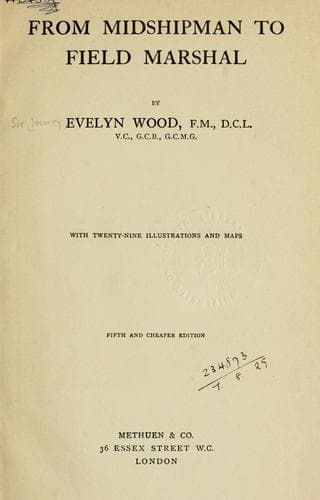
Great Britain -- History, Military -- 19th century; Marshals -- Great Britain -- Biography; Wood, Evelyn, 1838-1919
When Colonel W. F. Beatson received permission in 1857 to raise 1000
Irregular Horse, he undertook, with an imprest on account, to put them
into the Field within six months. This was approved, but it was not
anticipated to what the advance would amount. The Colonel allowed £40
for many of the horses, and £10 outfit for each rider, to be repaid
by monthly instalments of 4 rupees and 1 rupee respectively, thus
encumbering the Regiment with a crushing debt from which it could
never recover. This, however, was not the full extent of the evil; for
though the advances were given generally to men of position, later the
proprietary, or right of owning a horse, was in some cases transferred
to men of straw, and thus the Government lost security for their money.
The Regiment had been raised in a hurry, and showed all the
imperfections due to haste. Many of the Native officers had served
as non-commissioned officers; some of the non-commissioned officers
had served as Privates in the Haidarábád Contingent. Others had been
recruited from the Irregular Levies of the numerous minor potentates of
Central India. The Native officers were generally illiterate,[79] and
even the better educated were under the impression that in the mixing
of Hindustani and English words in command, the latter were Persian.
In each troop there was a sergeant who could read and write, and he
kept such accounts as there were, showing how much had been repaid to
Government; for the monthly instalments had been suspended while the
Regiment was on Field Service. These men, however, like many uneducated
men, had marvellous memories, and it was from them I adjusted and made
out the accounts of the Regiment, of which there were none previously
in existence, showing to whom the £25,000 advanced to the Regiment
in two years had been paid. The greater number of all Ranks were
Mussulmen, but there was one troop of Hindoos, in which a sergeant
named Burmadeen Singh was the ruling spirit, having much more influence
than the Native officers. He was a fine athletic man, but like most
of his race, not a horseman; he was twenty-five years of age, and
had lived according to the strictest letter of the Brahminical law,
a life of absolute purity, without tasting meat. The majority of the
men were poor riders, and the Regiment as such was undrilled. I never
wished to see Irregular Cavalry drilled with the precision of British
or Continental Cavalry, but these men were unable to advance 20 yards
in a line, or wheel to the right or left without jostling each other.
I adopted Rank Entire or Single Rank, as advocated by the Duke of
Wellington after Waterloo for all Cavalry.
Public-domain text, read in full here on John Shaqi.
Reviews
Reviews
No reviews yet
Be the first to share your thoughts on this work.
Elsewhere in the archive
Join the Discussion
Join the discussion
Sign in to leave a comment or review.
Sign InorCreate an account