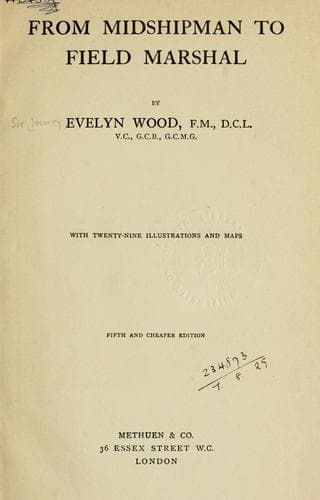
Great Britain -- History, Military -- 19th century; Marshals -- Great Britain -- Biography; Wood, Evelyn, 1838-1919
I spent my days when not inspecting outposts as follows:--Getting up
before daylight, I exercised the Regiment by troops till 8.30 a.m.;
saw the Native officers at orderly-room at 10; and then tried to
disentangle and arrange the Regimental accounts till 5 p.m., when I
went to the Horse Lines, and there remained till 7 p.m. This probably
had an exhausting effect on my nervous system, and made me anxious to
get away from what I feared must under the existing conditions remain
an unsatisfactory Corps, inasmuch as it was financially unsound. When
not engaged in trying to unravel the Regimental accounts, disciplining
or drilling the men, I spent my time in patrolling the jungles to
the north of Bersia. On the 9th January I went to Sindhara in the
afternoon, and searched all night for a leader named Mulloob Khan, the
Tontea (one-armed). This man was very troublesome from his courage and
determination, and it was to him that the doom of Chemmun Singh (see p.
179) was remitted.
I perceived there were some men in the Regiment who might become good
soldiers, and having issued an Order that no one would be promoted
unless he could ride fairly, read and write his own language, it became
necessary to establish a school. I provided a hut at a cost of about
£5; the furniture consisted of the piece of praying-carpet which good
Mussulmen carried on the saddle, and a payment of 6d. monthly from the
voluntary pupils remunerated the master, who soon had bearded men of
forty years of age under instruction.
Early in February an incident occurred indicating clearly the
difficulties of keeping order in the numerous States and petty
Chiefships of Central India. A Lieutenant, fifty years of age,
appearing at orderly-room one morning, said, “The rebels are gone,
there remain only robbers: may I have leave?” “For how long?” “I cannot
say--my business may take six months, but I will return the moment
it is done.” “Six months is a long time, Lieutenant.” “Yes, but I
have always done my duty, and I must have leave, or resign.” “Why so
urgent?” Becoming excited, he doffed his turban, saying, “Look at my
head, unshaven for months, and which I have sworn shall not be touched
till I have satisfaction for my nephew’s death.” “But what happened to
him?” “He was the Head of our family, and travelling, at nightfall was
near a village owned by an hereditary enemy. My nephew sent to ask if
he would be received as a friend. Being assured of hospitality, he went
in, was well entertained, and in the morning seen out of the village
with due ceremony, but three miles out was attacked in a pass and
killed, with all his servants but two who escaped.” “Take your leave,
Lieutenant; come back when you can.” Five weeks later he reappeared
with a cheerful face. “I am glad to see you back, Lieutenant. Have you
done your business satisfactorily?” “Quite so, my master, and my head
is shaved.” I asked him no more questions, but one of his friends told
me he had fully avenged his nephew’s death.
Public-domain text, read in full here on John Shaqi.
Reviews
Reviews
No reviews yet
Be the first to share your thoughts on this work.
Elsewhere in the archive
Join the Discussion
Join the discussion
Sign in to leave a comment or review.
Sign InorCreate an account