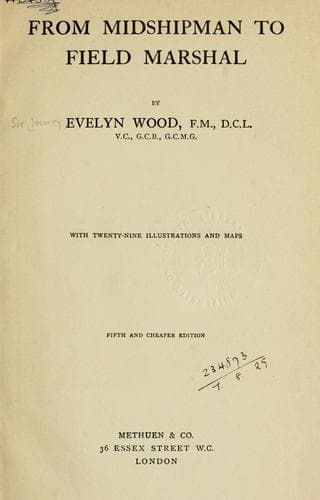
Great Britain -- History, Military -- 19th century; Marshals -- Great Britain -- Biography; Wood, Evelyn, 1838-1919
In the month of August I was sent to Rugeley, in Staffordshire, as the
Staff officer of General Sir Daniel Lysons, who taught me more of the
details of Camp life than anyone else under whom I have served. In the
month of May I had chanced to go into Sir Garnet Wolseley’s office in
London, and found him poring over a Dutch map of Ashanti, and he told
me, in reply to my question, that there was a King there who required
a lesson to bring him to a sense of the power of England. I said
laughingly, “There is a river half-way--the Prah--I will steer your
boat up;” and he turned round sharply, saying, “So you shall, if we
go.” It was while going up that river many months later that Sir John
Commerell was wounded.
I had been only a few days at Cannock Chase when I received a letter
from Arthur Eyre saying it was known at Aldershot that an Expedition
was about to start for the West Coast, and asking me to interest myself
in his behalf. I did so readily, from the following circumstance. When
riding one afternoon with my wife in the previous autumn, I noticed
Eyre trying five hunters in succession over the practice-jumps under
Tweezledown Hill. The horses had been bought by brother-officers at
Tattersall’s two days before, and their owners preferred that their
capabilities as hunters should be tested by some person other than the
purchasers. Marking the look of determination with which Eyre rode,
fixing his eyeglass by contracting the muscles of his brow, I observed
to my wife, “If I go on Service again, that boy shall come with me.”
So, on receiving Eyre’s note, I endorsed it with the curt remark, “The
son of a good soldier, his mother is a lady;” and he was selected.
It was the end of the month when I received a telegram from Sir
Garnet Wolseley: “We go out on the 12th September. You go with me on
Special Service.” Sir Garnet’s original intention had been to take two
battalions, each about 1300 strong, made up of picked men from the most
efficient battalions in the Army at home, each of which was to furnish
a company under its officers, and I was to have commanded one of these
battalions. The Commander-in-Chief, however, vetoed this principle,
which has, nevertheless, since been accepted in the organisation of
Mounted Infantry Regiments, and Sir Garnet was told he was to try and
do the work with what natives he could enlist, and that if he failed
he might have the three battalions first on the roster for Service.
This sound principle where large numbers are concerned was very
unsatisfactory when every man, whether an officer or in the Ranks, was
of value.
Public-domain text, read in full here on John Shaqi.
Reviews
Reviews
No reviews yet
Be the first to share your thoughts on this work.
Elsewhere in the archive
Join the Discussion
Join the discussion
Sign in to leave a comment or review.
Sign InorCreate an account