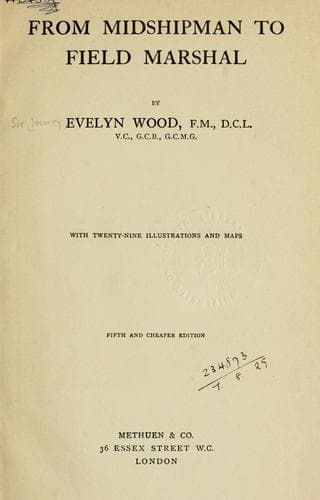
Great Britain -- History, Military -- 19th century; Marshals -- Great Britain -- Biography; Wood, Evelyn, 1838-1919
We were three-quarters of a mile from Ordasu, a village on the river
Ordah, which the Ashantis had anticipated holding; for when eventually
we drove them out of it, their food was still boiling in the cooking
vessels. I spent four hours trying to get the Bonny men to advance.
They had never been taught to fire, and their idea was to lie prone on
the ground, and, elevating the muzzle of the Snider in the air, fire it
as quickly as possible. My friend Essevie, who was there, with a few of
the Elmina company, showed the courage which he had always displayed,
and kicked and buffeted all black men, including his sons, with the
greatest impartiality, to drive them on; but we made little progress.
I think it was a mistake to allow the Blacks to head the advance. They
had built barracks, they had made bedsteads, they had taken every
outpost, no European soldier being disturbed at night, and we should
have got on faster if Europeans had been placed at once at the Head of
the track. There were few casualties--in fact, nearly all were confined
to the weak company of Wood’s Regiment, which lost 1 officer and 3 men
killed and 10 wounded, while the European Regiment supporting us with a
strength of 450 men had only 17 men wounded, most of them slightly.
The density of the Bush may be realised by this fact: while I was
teaching a Bonny man to fire, an Ashanti in the Bush discharged his
gun so close to the Bonny man’s head that the slugs did not spread,
and the force of the charge threw the man’s body from west to east
across the path. While Baker Russell and I were talking, he standing
up with the complete indifference to danger he always apparently felt,
I ordered Arthur Eyre to kneel down, like the other Europeans, but he
had scarcely done so when he was shot through the body, and from the
look in his face I saw that his last hours had come. He held up his
hand for me to remove his rings, saying, “Good-bye; please give them
to my mother.” The bullet had pierced the bladder, and he suffered
so terribly, in spite of the doctor giving him all the morphia that
his system would accept, that I felt relieved when he[131] died two
hours afterwards. He had accompanied me, except when in Hospital, in
every patrol and skirmish I undertook, and whenever he foresaw danger
invented some excuse to get between me and the enemy. He had inherited
his father’s impulsive temperament and all his determined courage, and
was moreover a delightful companion.
* * * * *
Public-domain text, read in full here on John Shaqi.
Reviews
Reviews
No reviews yet
Be the first to share your thoughts on this work.
Elsewhere in the archive
Join the Discussion
Join the discussion
Sign in to leave a comment or review.
Sign InorCreate an account