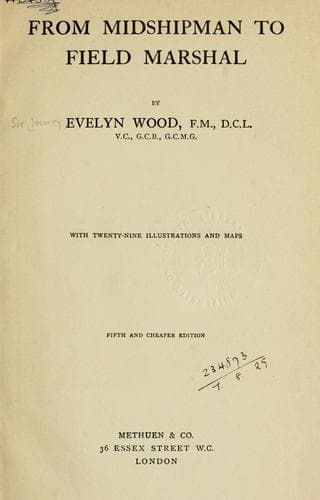
Great Britain -- History, Military -- 19th century; Marshals -- Great Britain -- Biography; Wood, Evelyn, 1838-1919
aid from books or other sources,” and I was invited to become Examiner
for all Boards in Great Britain. Although the suggested salary was
tempting, I declined, explaining officers would, if trusted, come in
time to see their duty in its true light, while their hands would
always be against an individual, whose questions would moreover become
stereotyped.
In order to have a little money for my favourite sport of hunting, I
accepted the office of Examiner in Tactics, but it was monotonous work
reading 100 answers to the same questions.
My friend Major-General Arthur Herbert got me appointed to his Division
for the Autumn Manœuvres in the following year, and on the 23rd April
1876 I was appointed Assistant Quartermaster-General at Aldershot,
where I served with a pleasant, but one of the most determined men I
ever met in my career, Colonel George Harman, later Military Secretary.
He was a fine horseman, slight in build, but with a handsome,
aristocratic face, and never afraid of saying the most unpleasant
truths to his superior officers if he thought it was his duty to do
so. Not having been to the Staff College, he liked me to arrange the
tactical schemes, and to the best of my recollection I framed, and got
permission for, the first example of Minor Tactics, in June 1877, to be
carried out by Field officers. The idea was so popular that the system
took root, and has been continued to this day. Previously to this Drill
Season no officer under the rank of a General had had, as a rule, the
opportunity of handling the three Arms of the Service in tactical
operations.
Public-domain text, read in full here on John Shaqi.
Reviews
Reviews
No reviews yet
Be the first to share your thoughts on this work.
Elsewhere in the archive
Join the Discussion
Join the discussion
Sign in to leave a comment or review.
Sign InorCreate an account