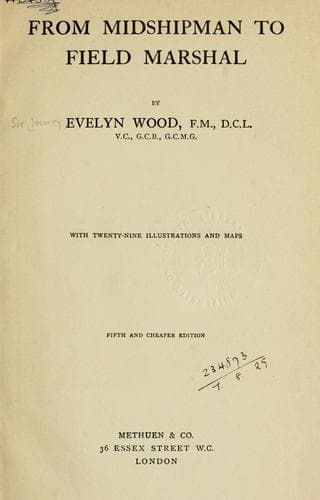
Great Britain -- History, Military -- 19th century; Marshals -- Great Britain -- Biography; Wood, Evelyn, 1838-1919
I lost four horses, which was provoking, but in a manner which made me
admire the audacity of the Kafirs. After I had re-established my line
of Fingoes, some 20 Gaikas ran out in the open, from a spot where the
Fingoe line was weak. The position was awkward, because I had nobody
with me except my personal escort of 8 men and the horse-holders of the
Frontier Light Horse, the other men being all below in the Bush. When
we fired, the horses broke away from the horse-holders and careered
over the plateau, four of them running northwards in a narrow glade
where the Bush closes in on either hand. The horses chased by my
orderly ran close to the trees, from which Gaikas darting out pulled
them into bush so dense that our men who were in the ravine, and later
emerged close to the place, saw neither Kafirs nor horses.
At nightfall we marched back to Burns Hill, where I had to provide
food and shelter for the hungry, coatless companies, 90th Light
Infantry. They sheltered in the Mission Church, and as there were
sheep close at hand, lumps of mutton were soon broiled on the fires.
Next day Lonsdale’s and Streatfield’s Fingoes moving from the Rabula
Valley through the Tutu Bush, killed 20 of Seyolo’s men with but few
casualties, while with the 90th companies and Frontier Light Horse
I held the plateau. On the following day the Fingoes advancing from
the Rabula, with two companies of the 90th and Frontier Light Horse,
again went through the Tutu Bush and drove out some of Seyolo’s men,
who, after a skirmish with the General’s small Force, then encamped at
Bailie’s Grave, succeeded in getting across to the Buffalo Range. Next
day I heard that another small tribe had broken out and were making for
the Tutu, and I followed them with a few mounted men, but only overtook
their women, the men escaping into the Zanyorkwe Ravine.
Now for about three weeks the Rebels remained unmolested, and Seyolo
appreciating the situation, coming down from the Intaba Indoda
Bush, destroyed all the Fingoe huts within two miles, carrying off
large supplies of food and cattle. On the 23rd April he attacked
Streatfield’s Fingoes, but was beaten back, although they were obliged
to shift their camp, as it was too close into the Bush.
Captain Bowker,[150] whose men had all gone home, came to me as a
Staff officer, and was very useful in many ways, as I was new to the
country. He told me a great deal that was interesting, and was one of
those who agreed with me as to our obligations in sparing Kafirs who
no longer resisted. Many of the Colonists with whom I had talked had
disagreed with me on this subject, alleging that as the Kafirs never
spared us we should treat them in a similar manner. Several said to me
on the Buffalo Mountains, “You don’t understand; the women you want to
feed would gladly inflict nameless tortures on you if you were their
prisoner.”
Public-domain text, read in full here on John Shaqi.
Reviews
Reviews
No reviews yet
Be the first to share your thoughts on this work.
Elsewhere in the archive
Join the Discussion
Join the discussion
Sign in to leave a comment or review.
Sign InorCreate an account