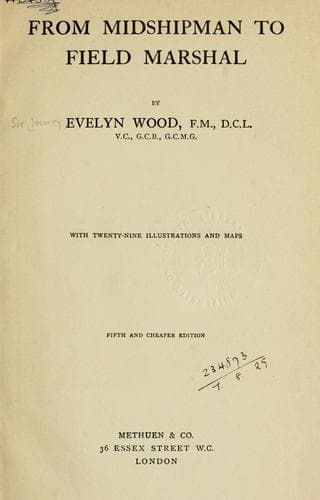
Great Britain -- History, Military -- 19th century; Marshals -- Great Britain -- Biography; Wood, Evelyn, 1838-1919
the lad’s face he felt the rebuke, I added, “I do not want, my boy, all
my eggs in one basket.” Ten minutes later, when we had advanced 400
or 500 yards, or one-third of the distance to the plateau, the firing
increased in intensity, especially on the northern side, although
nearly all the bullets cut the trees, and at one time my pony’s back
was covered with leaves, which fell like snow in a winter scene at a
theatre. The Gaikas approached closer and closer, till a Kafir, almost
touching Stevens, fired, and knocked a big hole in his face. I was
sitting in the centre of the company, and beckoning to Saltmarshe, as
his Captain was carried away, said, “Now it is your turn.” I noticed
that, although his face was set, and he was still eager to fight,
yet the fall of his friend had sobered him, for he asked in a quiet
voice, “What am I to do, sir?” “Go to the head of the company, fire two
or three rounds, then advance 50 yards and drop again.” He had made
one advance only, when a Gaika fired so close to him that his chest
was knocked away by the charge. The Rebels now made a rush, and the
Hottentots, who were on the southern side of the path, whence there
came but little fire, ran down the path, carrying with them half a
dozen of my men, who had been near Saltmarshe. Colour-Sergeant Smith, a
little man, so short that I often wondered who could have enlisted him,
had a heart entirely out of proportion to the size of his body, using
most opprobrious language to the men, led them forward again.
I sent back for Major Cherry, who was in command of the detachment, as
the company was now without officers. At that moment Captain Stuart
Smith, Royal Artillery, asked if he might bring up a gun, and on my
saying I was afraid we should not get the horses clear of the muzzles,
he observed cheerfully, “Oh, it does not matter if we shoot them;” and
in a couple of minutes he had two guns unlimbered, and firing case
into the Bush close on the ground from whence most of the fatal shots
had come. Major Cherry now led on the company, and in a few minutes
the Gaikas drew off, and we got on to the plateau with but little
further loss. I then reaped the advantage of my ride the previous day
to Alice (Fort Hare), where I had bought several yards of calico,
for with a strange want of forethought the signalling equipment had
been left at Cape Town. I was now able to report to General Thesiger
across the ravine, for we were standing only 1600 yards apart, and the
Gaikas had been driven below the plateau into the ravine. This fight
ended disastrously for Seyolo’s men; our columns converging at the
common centre, met them as they tried each avenue of escape, and after
nightfall, crossing the King William’s Town-Keiskamma Hoek road, they
took refuge in the Perie Bush.
Public-domain text, read in full here on John Shaqi.
Reviews
Reviews
No reviews yet
Be the first to share your thoughts on this work.
Elsewhere in the archive
Join the Discussion
Join the discussion
Sign in to leave a comment or review.
Sign InorCreate an account