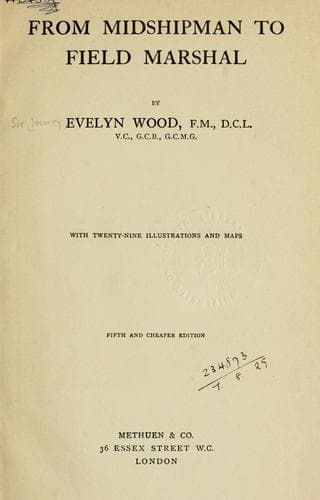
Great Britain -- History, Military -- 19th century; Marshals -- Great Britain -- Biography; Wood, Evelyn, 1838-1919
After some conversation with Mr. Filter and his family, I went to see
Faku, the Chief sent by Cetewayo to frighten the Dutch settlers away
from the border, which he had done effectually. I was curious to see
the so-called military Kraal about which I had read while still in
England. It was made of wattles, 6 feet in height, and 22 yards in
diameter. He asked me, “Are you going to invade our country?” “No, not
without orders; and so far as I know such orders are not contemplated.”
He was impressed by my being unarmed, carrying only a riding-whip,
while he sat surrounded by twenty of his warriors. The result of
my visit was that he sent to Cetewayo, saying he was satisfied
that no immediate invasion of the country would be made from the
Luneberg-Utrecht side, and the Maqulusi tribe, which had been assembled
in the Inhlobane Mountains, was sent home.
Next day I started with my interpreter, Paliso, who had accompanied
me from the Amatola district, Kaffraria, to ride southwards, and then
along the Yagpad (hunting road). I intended to stop the night at
Potter’s store, 35 miles distant, on the Pemvane River, which, as I was
told at Luneberg, the owner, from his friendship with the Maqulusi, had
been able to keep open, although the district had been abandoned by the
Dutchmen. When I reached it, however, I found it was practically empty,
and its owner had left.
The Zulus were in a state of excitement: four regiments had recently
gone to Ulundi on the King’s summons, and four more were then moving
down. The men to whom we spoke were so truculent in their behaviour,
asking when the Germans were going to obey Cetewayo’s orders and
leave Luneberg, and showing, moreover, so strong a desire to take
my kit, that I decided to go on another 35 miles until I got out of
the disputed territory. In my 70-mile ride that day the result of
Cetewayo’s message was apparent, for there was only one farmhouse with
a roof on it, and most of the gardens and fields were being cultivated
by Zulus. The mules pulling the Cape cart with my luggage were quite
fresh at nightfall when I crossed the Blood River, but my three horses
all showed signs of fatigue, and after I halted, the horse I bought
at Cape Town, which had gone gaily up to that time, died after ten
minutes’ pain.
I spent the next ten days purchasing and organising transport, in
obtaining which and some mealies I expended £10,000, which rose to over
£50,000 by the 1st June 1879. I was obliged to employ my one Staff
officer in examining roads, and thus I had to do more than I was really
able to carry out to my satisfaction.
Public-domain text, read in full here on John Shaqi.
Reviews
Reviews
No reviews yet
Be the first to share your thoughts on this work.
Elsewhere in the archive
Join the Discussion
Join the discussion
Sign in to leave a comment or review.
Sign InorCreate an account