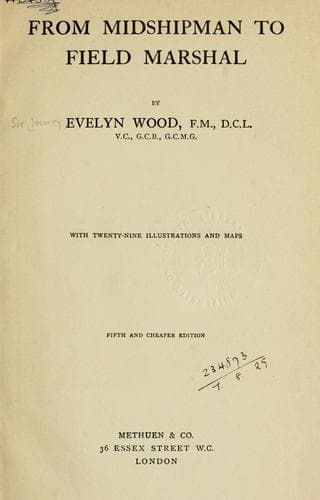
Great Britain -- History, Military -- 19th century; Marshals -- Great Britain -- Biography; Wood, Evelyn, 1838-1919
On the night of the 3rd a party of 150 Bluejackets were dragging guns
down to the Left Attack. For some reason to me unknown, they, it was
said owing to injudicious treatment of the officers, turned sulky, and
at a further unpalatable order given just as they got the guns on the
rising ground overlooking the Left Attack trenches, the men dropped
the drag ropes, and in spite of the expostulations and orders of their
officers, returned to camp. Next day all these men were handed over
to me for punishment on the principle of “Watch and watch,” but the
watch in their case consisted of manual labour. They were employed in
carrying duties, and were not to be allowed more rest in camp than four
hours. The unusual experiment of giving a young Midshipman the command
of 150 men who had behaved badly ended satisfactorily, the men being
forgiven after undergoing a week’s punishment.
Towards the end of February we re-armed the 21-gun battery throughout,
mounting some 8-inch 65 cwt. guns, and long 32-pounders, 56 cwt.,
besides two more 68-pounders, and another Lancaster, 95 cwt. gun. We
had now more soldiers to guard our Position. The Right Attack trenches,
which extended over a mile, had been often held by 350, and one night
by 300 men; but reinforcements were now arriving. Admiral Boxer, who
came to Balaklava and took charge of the Port at the end of January,
effected vast improvements: he built landing-stages, and evolved order
out of Chaos, and thus, when carrying parties went down to the harbour,
they were no longer kept waiting for their loads.
The last week of February, the 2nd Division was annoyed by the shells
thrown up from two Russian men-of-war, moored in the outer harbour.
Their guns were slung on deck at an angle of 45°. Captain Peel worked
out a scheme for the capture of the vessel, on which he did me the
honour of asking my opinion. He proposed to take six boats after dark
down the face of the Inkerman cliff, almost opposite the steamers,
which were lying 300 yards from the shore. We were to launch the
boats, board the ships, and kill or drive below the few men only who
would be on deck, as we believed, after the crew had retired to rest.
If we succeeded, we were to tow the ships ashore, or if necessary,
higher up the harbour, immediately under the hill on the crest of
which the critical struggle of Inkerman took place. I was silent, but
when pressed for an opinion as to the probable result I frankly said
that I thought its success was more than doubtful; I argued, however,
that our loss of men would not be in vain, for the Russians would
probably withdraw their steamers, while our men would be encouraged by
the adventurous nature of the undertaking. I gathered later that Lord
Raglan was in favour of the attempt, but the Naval Commander-in-Chief
vetoed it.
Public-domain text, read in full here on John Shaqi.
Reviews
Reviews
No reviews yet
Be the first to share your thoughts on this work.
Elsewhere in the archive
Join the Discussion
Join the discussion
Sign in to leave a comment or review.
Sign InorCreate an account